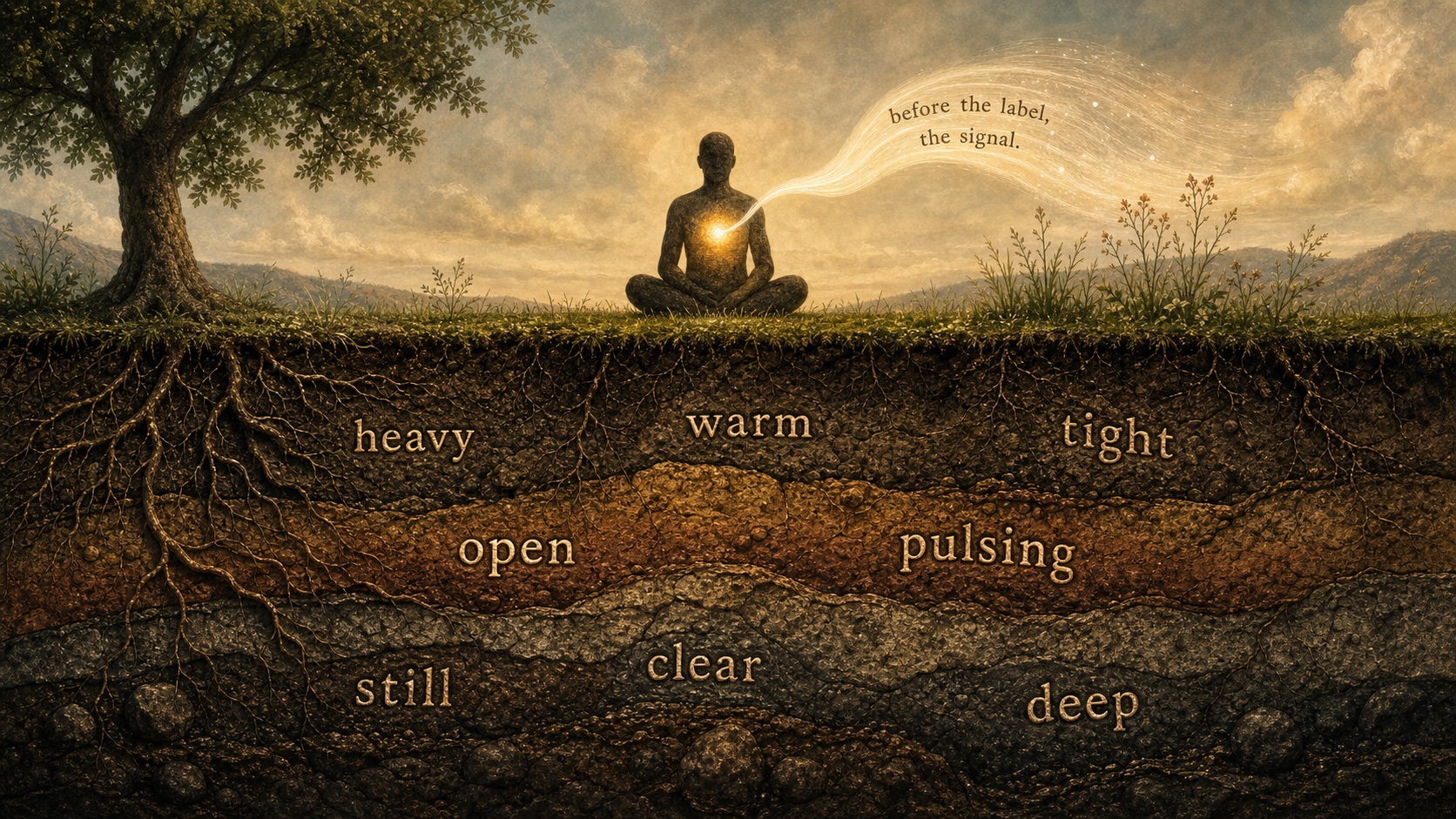
There's something I want to put at the center of how you describe your sits. It's a small shift, and I think it will change how you relate to your own experience.
When we try to say what happened in a sit, most of us reach for a word that sums it up. "It was deep." "I felt present." "There was a lot of resistance." These words aren't wrong. But they're already one step away from what actually happened. They're the mind's conclusion about the experience, not the experience itself. The mind narrates faster than it notices, and by the time a report reaches your tongue, it's usually already a story.
What I'm inviting us into is more intimate than that. Before the label, there's a signal. A sensation, somewhere in the body, with a texture and a temperature and a quality of movement or stillness. That's the real thing. That's what we're learning to describe.
So instead of "I felt anxious," what if you said: there was a tightness across my chest, my breath went shallow, something pressured and upward in my throat. Instead of "there was resistance": a kind of pulling back, a contraction just below my sternum, like something that didn't want to open.
When you describe it that way, something happens. The experience stays alive instead of becoming a report from a place you've already left.
The summary word is efficient, and that's exactly the problem. It lets you file the experience and move on before you've finished meeting it. "Resistance" closes the folder. The contraction below your sternum is still open.
The vocabulary for staying open is simple. Heavy or light. Open or closed. Moving or still. Warm or cool. Buzzing, pulsing, tight, dissolving. Boring words. Exact words. That's exactly why they work.
A working vocabulary
None of these words are clever, and that's the point. Each one names something you can actually feel. Reach for them when the summary word arrives too fast.
| Quality | Words |
|---|---|
| Location & orientation | here · there · center · edge · surface · deep · front · back · left · right · above · below · inside · outside · spreading · localized |
| Pressure & weight | heavy · light · dense · airy · thick · thin · compressed · pressured · weighted · buoyant · solid · hollow |
| Temperature | warm · cool · hot · cold · burning · icy · neutral · feverish · flushed · chilled |
| Texture | rough · smooth · grainy · silky · jagged · soft · hard · fuzzy · raw · tender |
| Movement | still · moving · pulsing · throbbing · vibrating · buzzing · trembling · flowing · churning · spinning · rising · falling · expanding · contracting · oscillating · radiating · drifting |
| Tension & tone | tight · loose · clenched · released · braced · relaxed · wound · slack · rigid · fluid · knotted · open |
| Size & shape | large · small · wide · narrow · round · sharp · pointed · diffuse · concentrated · vast · pinpoint · spreading · shrinking |
| Rhythm & duration | constant · intermittent · pulsing · steady · fleeting · lingering · sudden · gradual · building · fading · recurring |
| Clarity | clear · murky · foggy · vivid · faint · distinct · vague · sharp · blurry · defined |
| Edges | bounded · unbounded · contained · spilling · leaking · sealed · open-ended · crisp · dissolving |
An act of care
This isn't about being more precise for precision's sake. It's an act of care. Care for your own experience, care for what's real. When you take the time to find the actual words for what happened, you aren't performing practice. You're in it.
So whenever you sit down to describe what happened, keep asking the same few things.
Where did you feel that?
What was its texture?
What was happening in your body right before you'd call it that?
Not to interrogate yourself. To be with your experience, all the way down.
The label is where you went. The signal is where you were.
This is an excerpt, one of Albert's many writings in our private Discord, reserved for bootcamp members. Sign up for the newsletter to hear when the next bootcamp opens, and to receive more writing like this.