The Patterns of Exit
The three reliable ways you leave a moment: insisting, distancing, and fading
Practice This Week
This week, pick one recurring friction — a conversation, a sit, a daily task where you feel resistance — and watch how you leave it. Don't try to stay. Just identify the maneuver: are you pushing harder (insisting), stepping back into commentary (distancing), or going quiet and low-energy (fading)? Name it once, without judgment. That naming is the beginning of a different relationship with the pattern.
Discussion
The live discussion room from this lesson. Watch it as another transmission — feel into the others as they ask questions and speak, and stay open to direct relating.

Discussion 2 - Room 1
Led by Laurenz
The complete Lesson 2 discussion room, unedited, led by Laurenz. Practitioners working the teaching in real time — questions, resistance, and live guidance.

Discussion 2 - Room 2
Led by Albert
The complete Lesson 2 discussion room, unedited, led by Albert. Practitioners working the teaching in real time — questions, resistance, and live guidance.

Discussion 2 - Room 3
Led by Shreyash
The complete Lesson 2 discussion room, unedited, led by Shreyash. Practitioners working the teaching in real time — questions, resistance, and live guidance.
Reading Material
The Exit Patterns
Day 1 exposed the exit as a subtle movement of leaving. What follows is a stronger claim:
We do not leave experience in arbitrary ways. We leave in ways that are patterned, conditioned, and reliable.
That is the real force of this teaching. It is not introducing three interesting categories. It is collapsing the belief that suffering is primarily situational, accidental, or caused by the external difficulty of the moment. Human suffering is structured by a repeatable way of relating to reality.
The issue is not merely that life is difficult, or that there are painful experiences, or even that attention gets pulled. When contact becomes unstable, the mind reflexively reorganizes itself in familiar ways to recover coherence. Those maneuvers work. That is why they persist.
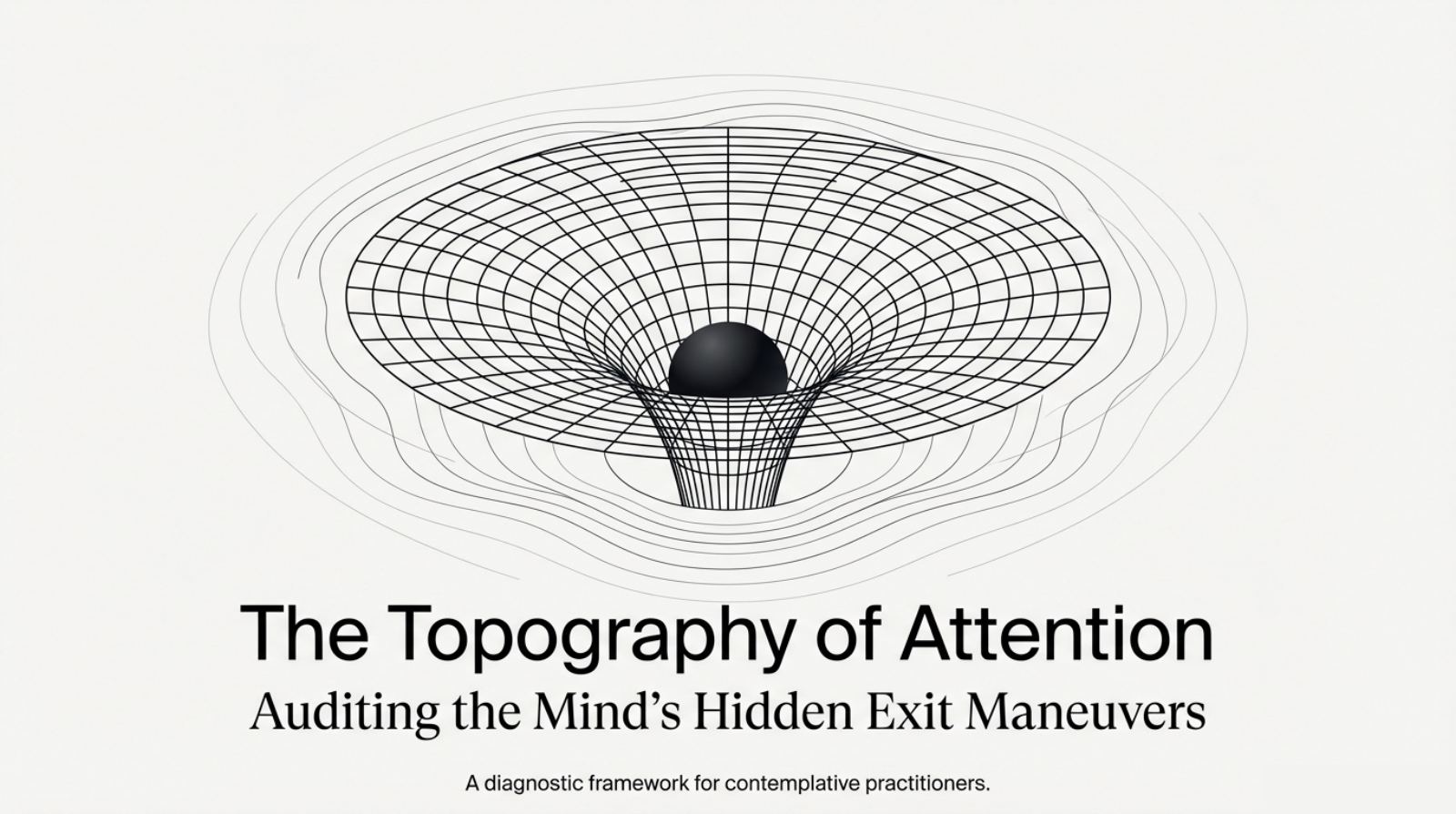
Suffering is not an inherent flaw in experience, nor an affliction that arrives from outside. It is a byproduct of how we participate in what is happening. The real object of investigation is not the world "out there," nor some bad inner state to be removed, but the structure of our own participation: how attention moves, how contention forms, how intention resolves that tension into a strategy.
 Tap to enlarge
The Deeper View Problem
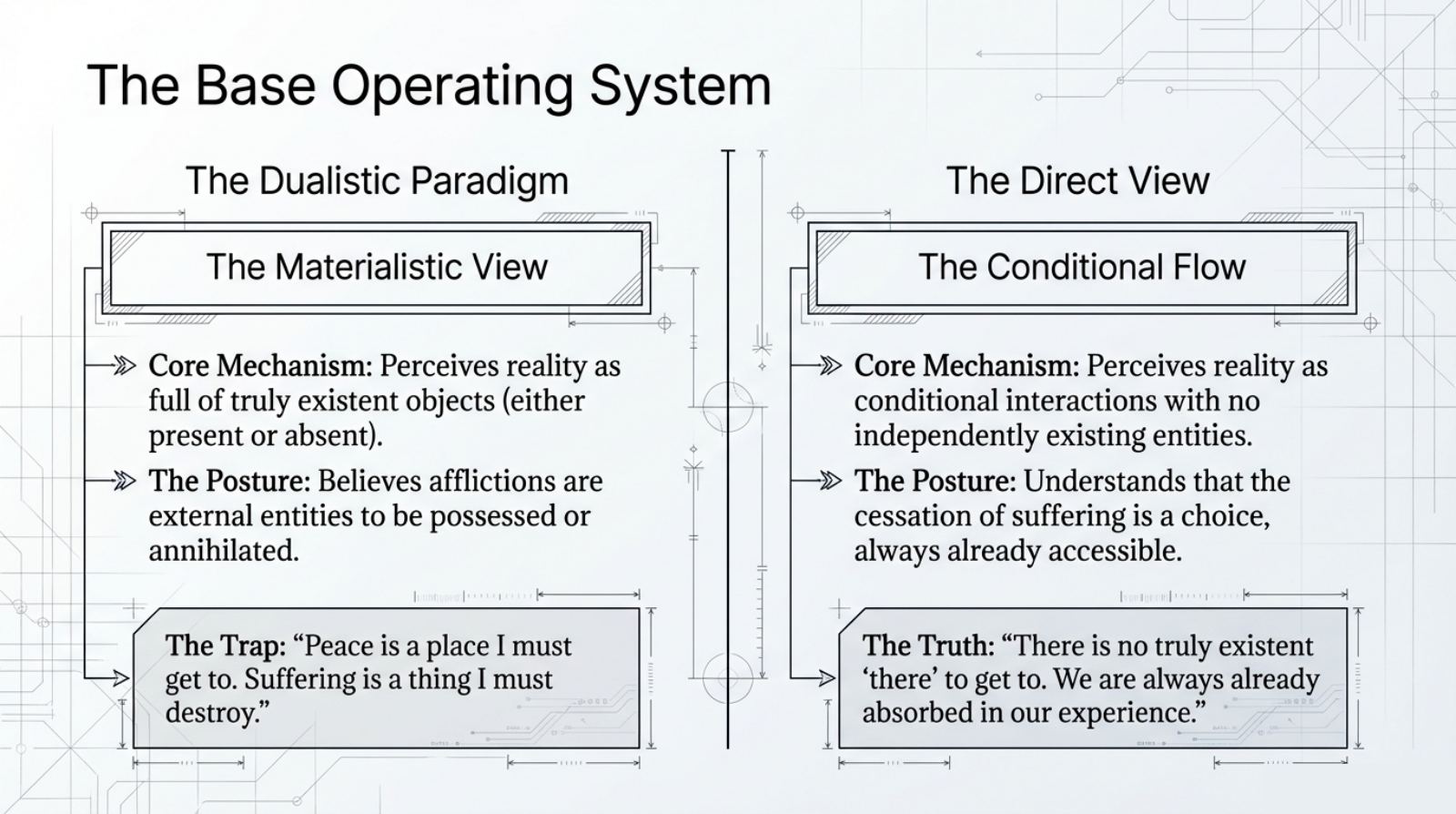
A major layer of this teaching is philosophical, but not for its own sake. It explains why these exit patterns arise so automatically. The basic modern posture is to assume that reality is made up of truly existent things — objects, states, conditions, identities, problems, attainments — that are either simply there or not there.
From this posture:
- Suffering appears as a kind of thing one has.
- Ignorance appears as a thing one is afflicted by.
- Liberation appears as some other thing or place one must get to.
Under these assumptions, the path becomes organized around acquisition and removal: get the right state, remove the bad state, attain the cessation, eliminate the affliction.
The critique here is not that distinctions are useless. It is that we confuse functional distinctions with ontological realities. We need distinctions to act, orient, navigate, and train. But in ordinary cognition, we do not see that these distinctions are decisions shaped by conditions, aims, and utility. We treat them as if the world itself is declaring its own fixed structure, rather than recognizing that our cognition is actively organizing reality according to what has worked before and what it is currently trying to accomplish.
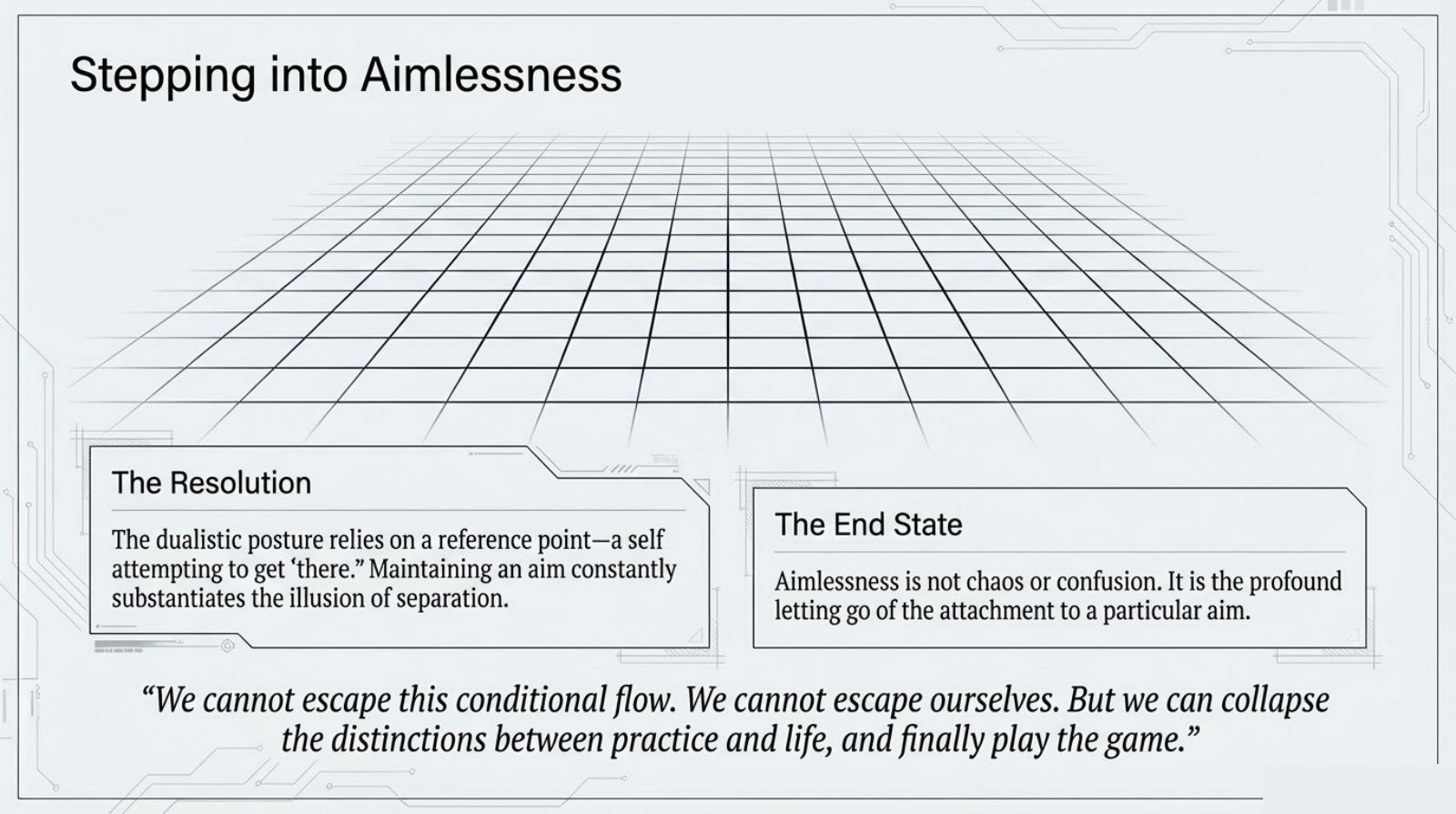
That mistake creates the basis for a dualistic posture: self here, goal there, problem over there, method over here, liberation somewhere else.
If reality is tacitly framed as a field of separate things, and if relief or resolution is framed as somewhere else, then of course the mind will keep trying to stabilize the moment in accordance with its aim. The exit maneuvers are not random defects. They are the natural consequences of a mind organized around separation.
 Tap to enlarge
Karma as Self-Perpetuating Conditioning
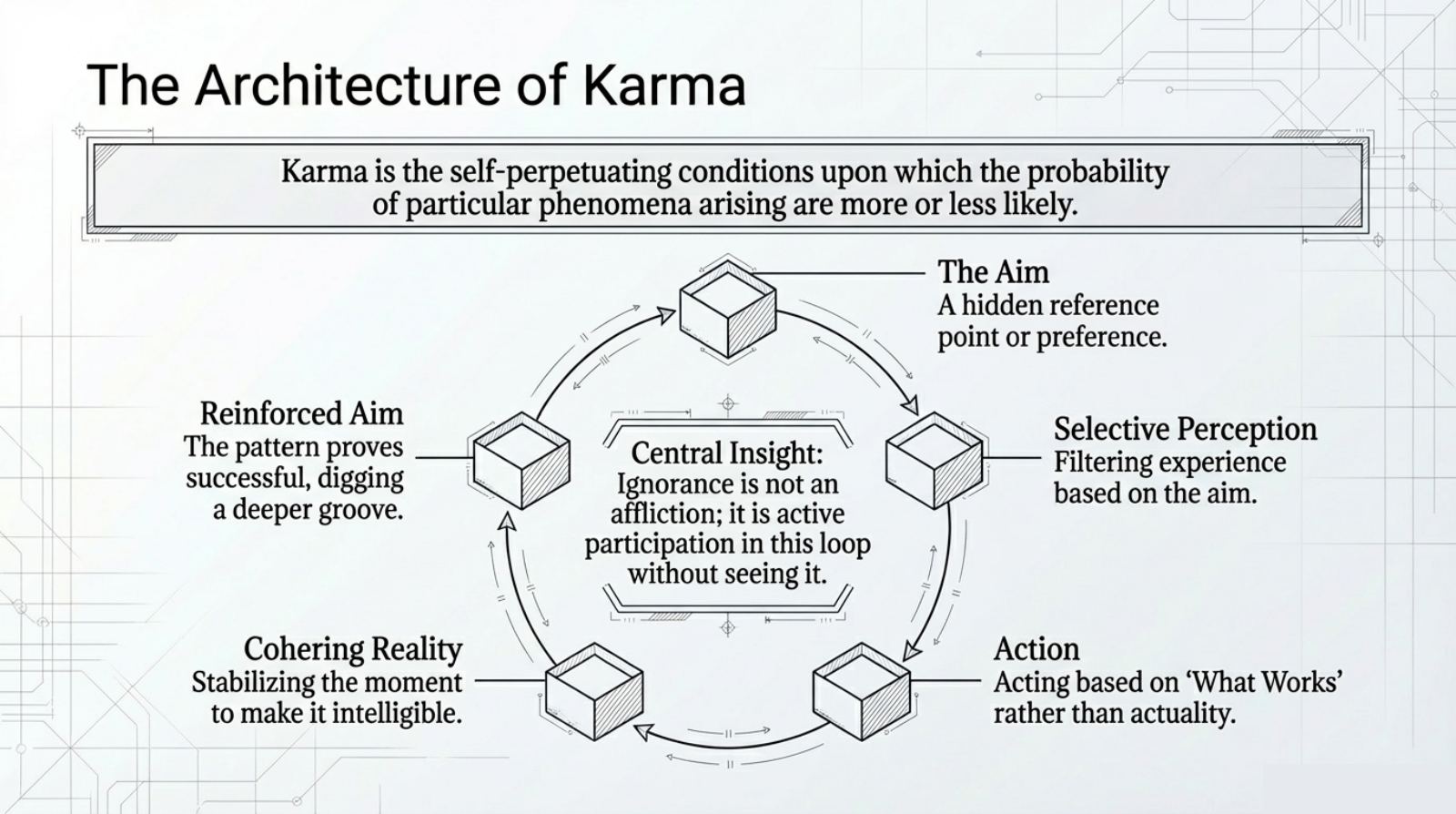
Karma is the self-perpetuating conditions under which certain phenomena become more likely to arise. It is the ongoing patterned way a being becomes what it is. Not just that we have traits — we inhabit loops of perception, valuation, choice, and reinforcement that continuously recreate a familiar reality.
Karma does not primarily operate by abstract destiny. It operates by conditioned perception. We do not perceive what is in some neutral sense. We perceive according to what has worked relative to our aims. Our experience is already filtered by survival, preference, aversion, valuation, and prior learning.
We keep recognizing what confirms the loop, and we keep acting in ways that reinforce it. That is why ignorance is a choice — not because it feels like an explicit decision, but because it is an ongoing participatory refusal to look at what would destabilize our current organization of self and world. This is structural responsibility — not moral blame, not self-condemnation.
 Tap to enlarge
Suffering is Not Pain
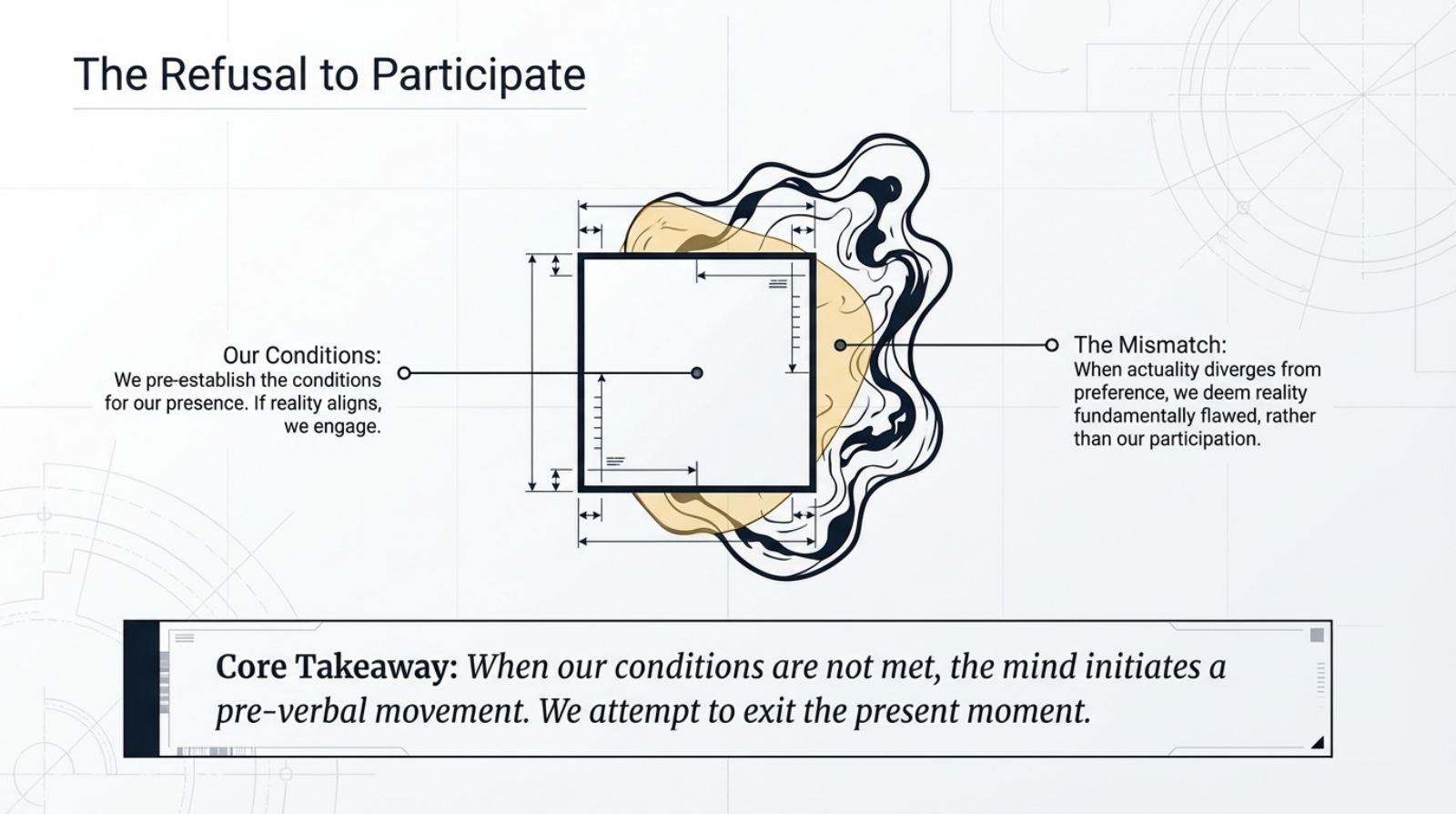
Much practice becomes confused because practitioners covertly assume that not suffering means eliminating discomfort, effort, instability, or intensity. That assumption already biases the whole investigation. It makes reality appear fundamentally flawed whenever it does not match preferred conditions.
Suffering is not simply unpleasantness. It is the friction generated when we refuse participation in the actuality of the moment. We set the terms under which we are willing to be present. When those terms are not met, we attempt not to participate. The problem is not pain alone, nor discomfort alone. The problem is the movement that says: this should not be here; I should not have to meet this; I will not remain with this as it is.
 Tap to enlarge
The Three Exit Maneuvers
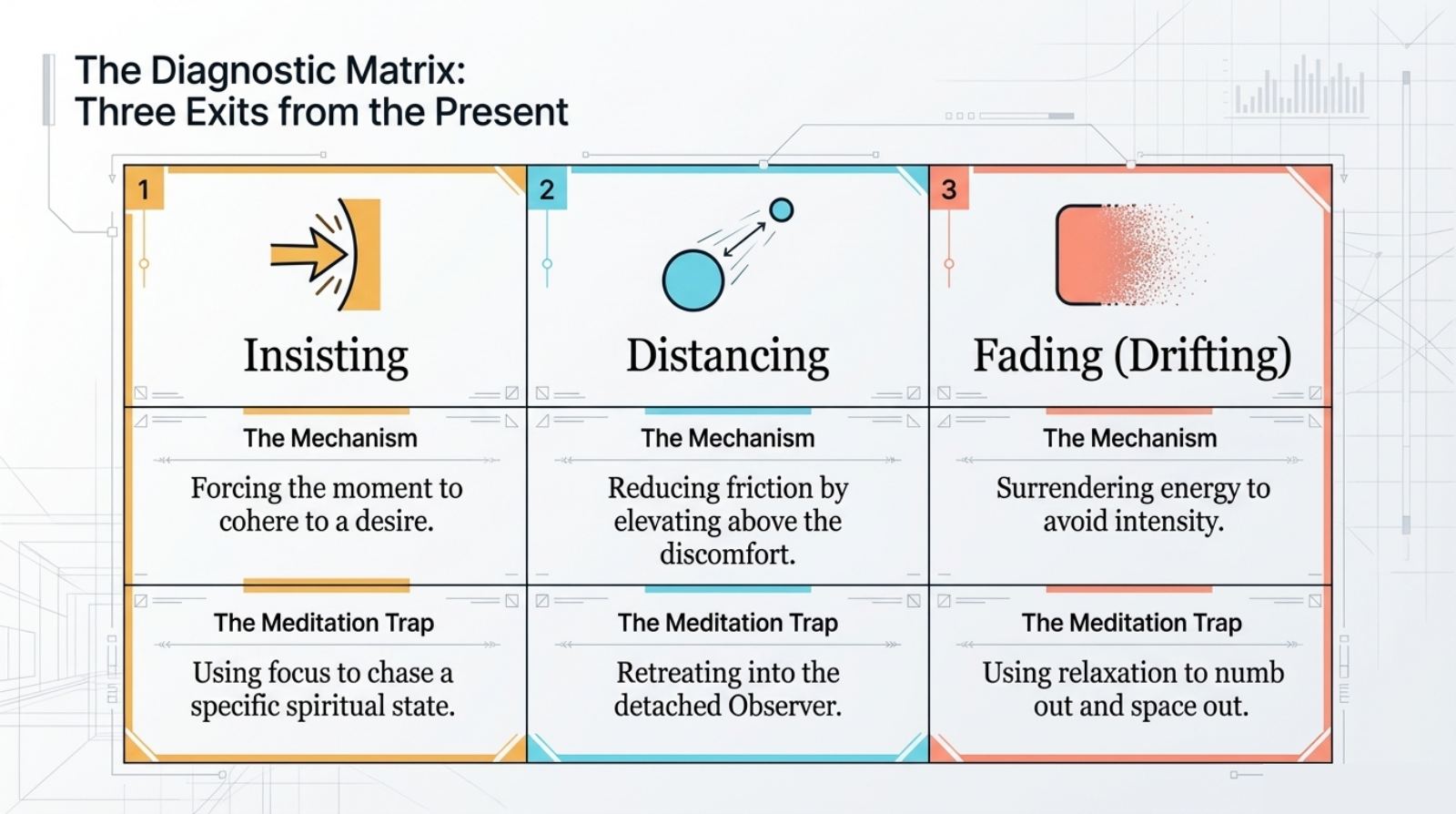
These are not personality types. They are stabilization strategies.
 Tap to enlarge
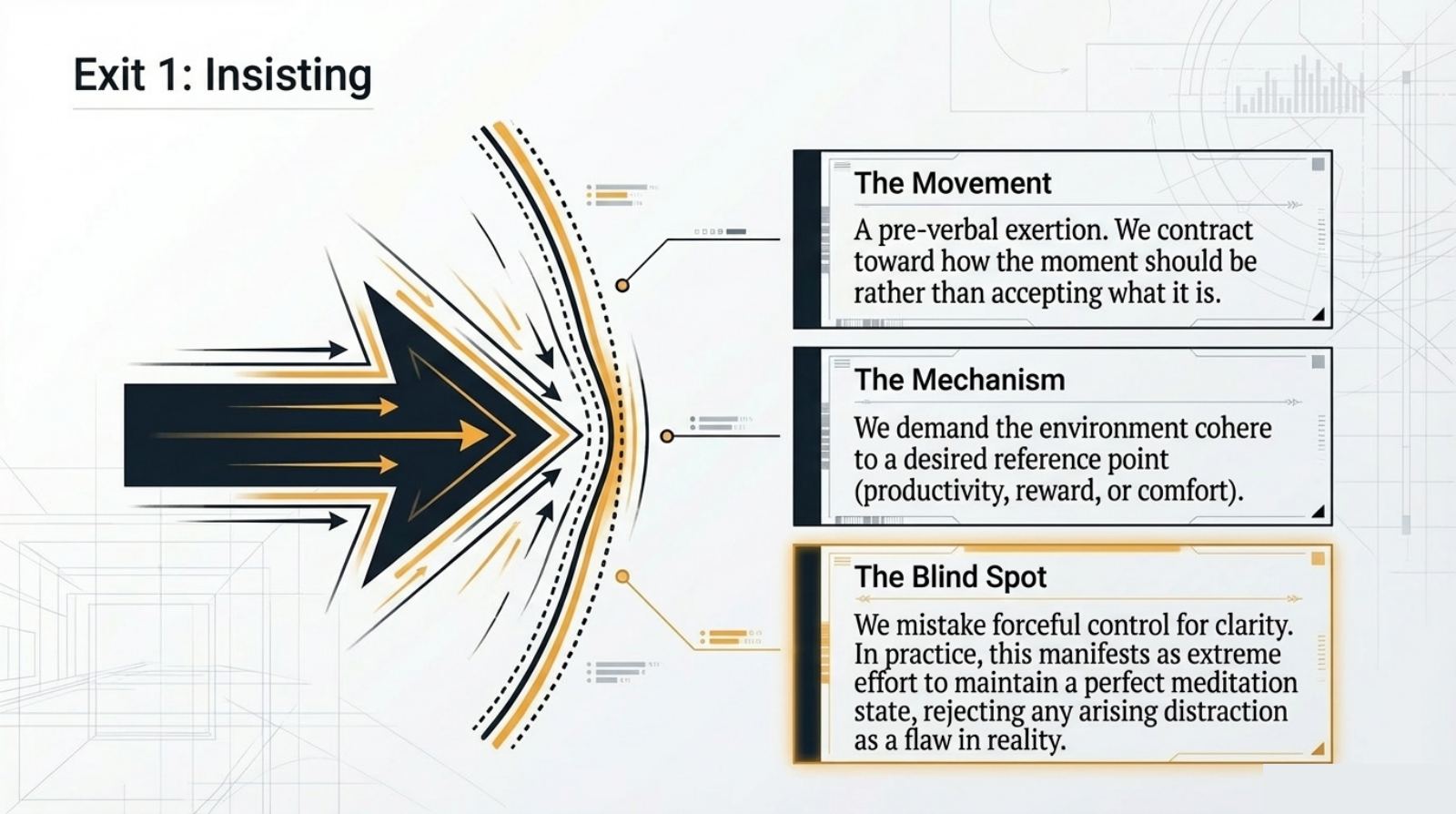
Insisting — the basic move is "this should be different." The mind contracts toward how the moment should be rather than accepting what it is. It demands the environment cohere to a desired reference point: productivity, reward, comfort. The blind spot is mistaking forceful control for clarity.
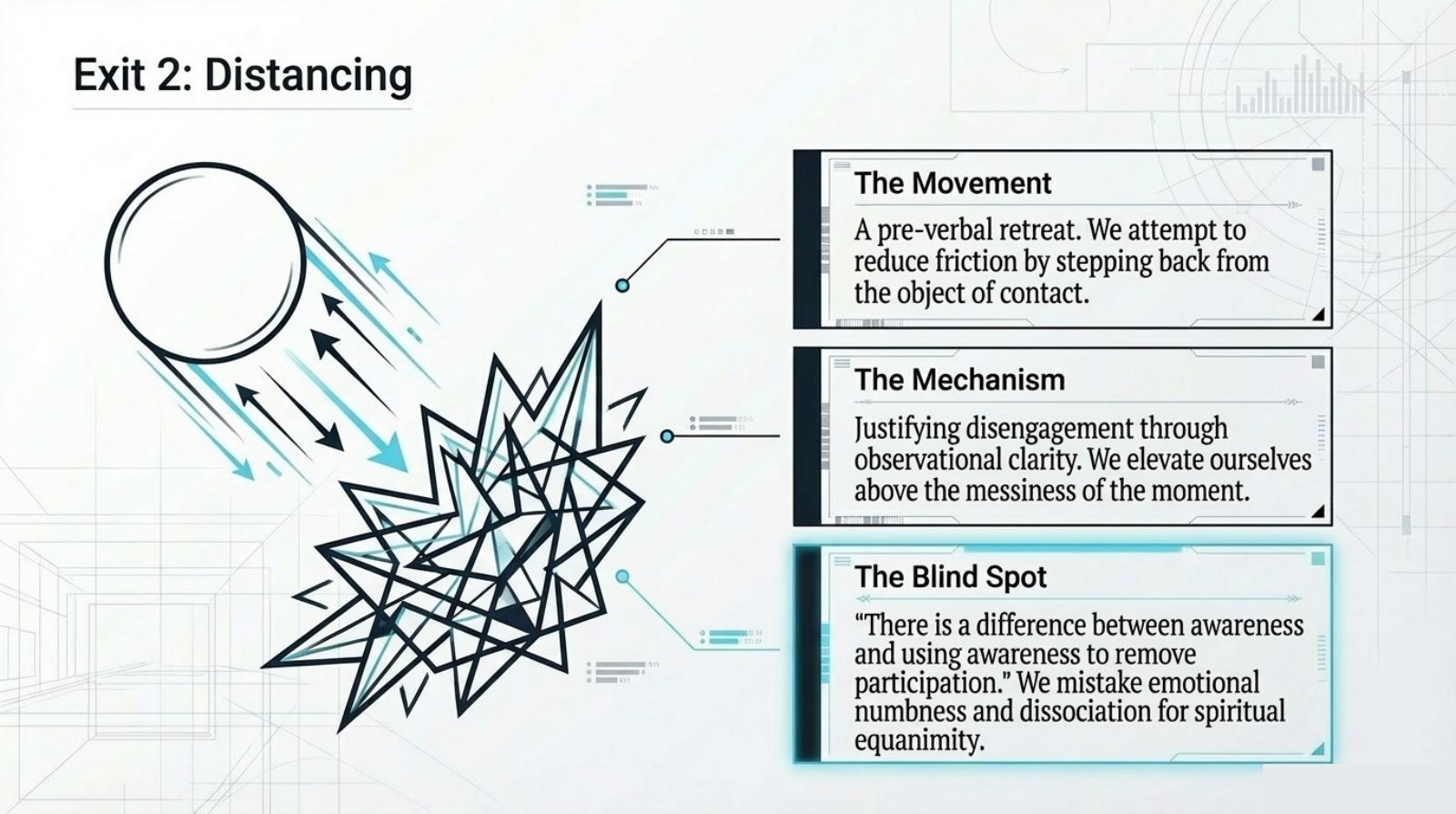
Distancing — the basic move is stepping back from discomfort. Friction is reduced by elevating above the object of contact. Disengagement is justified through observational clarity — we elevate ourselves above the messiness of the moment. The blind spot is mistaking emotional numbness and dissociation for spiritual equanimity.
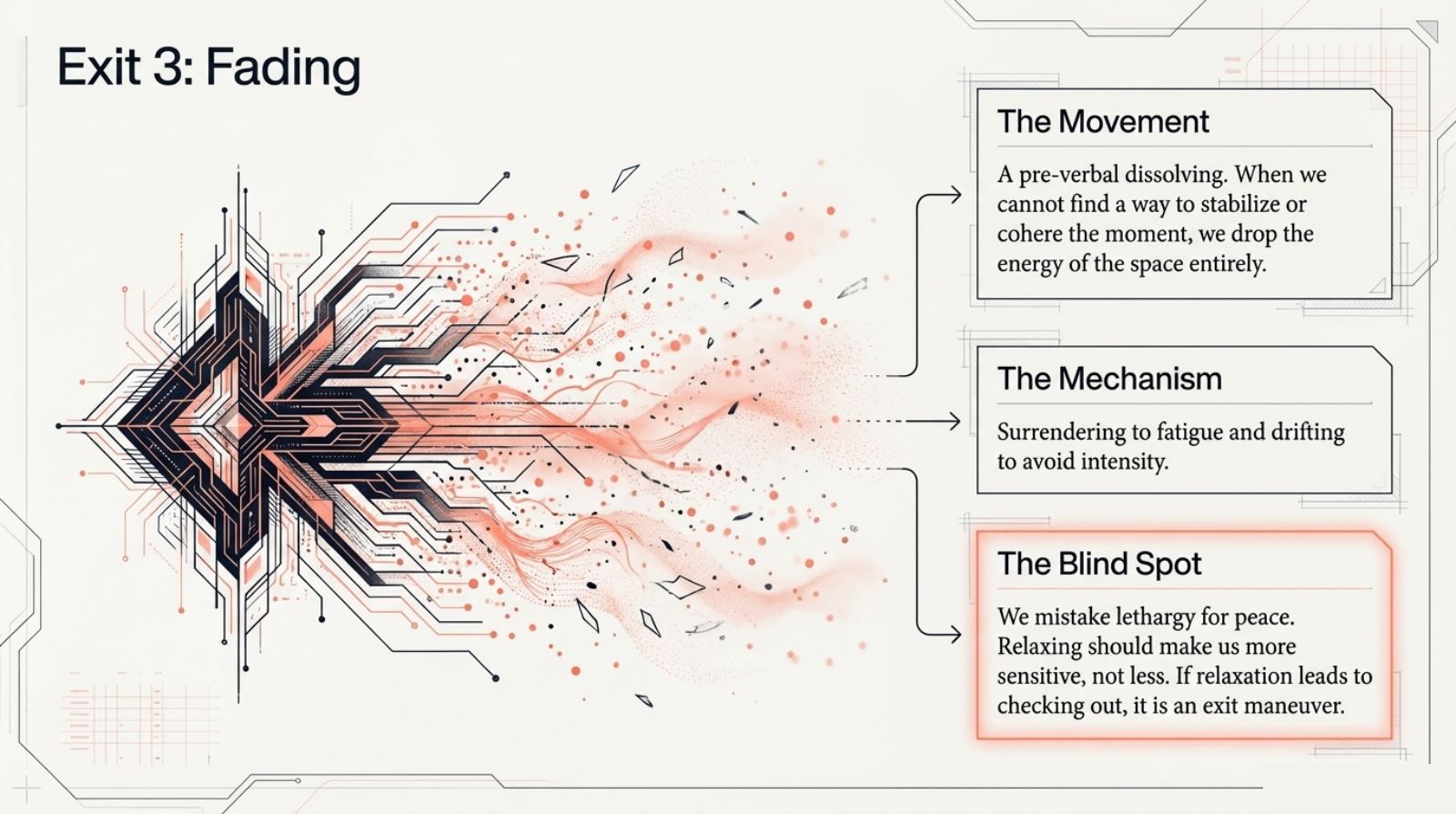
Fading / Drifting — the basic move is lowering energy and intensity. When the mind cannot find a way to stabilize or cohere the moment, it drops the energy of the space entirely. Fatigue is surrendered to, drift is used to avoid intensity. The blind spot is mistaking lethargy for peace.
These maneuvers are effective. Productivity rewards insisting. Meditation can reward distancing. Fatigue rewards drifting. We miss them because they work. They efficiently solve the immediate problem of instability — but they do not solve the deeper structure that keeps recreating instability in the first place.
Why Practice Itself Becomes Part of the Problem
The maneuvers can mimic what meditation practice looks like:
- Insisting shows up as trying to force the sit into the right state.
- Distancing shows up as retreat into the observer collecting insights.
- Drifting shows up as quiet, low-energy collapse mistaken for peace.
 Tap to enlarge
 Tap to enlarge
 Tap to enlarge
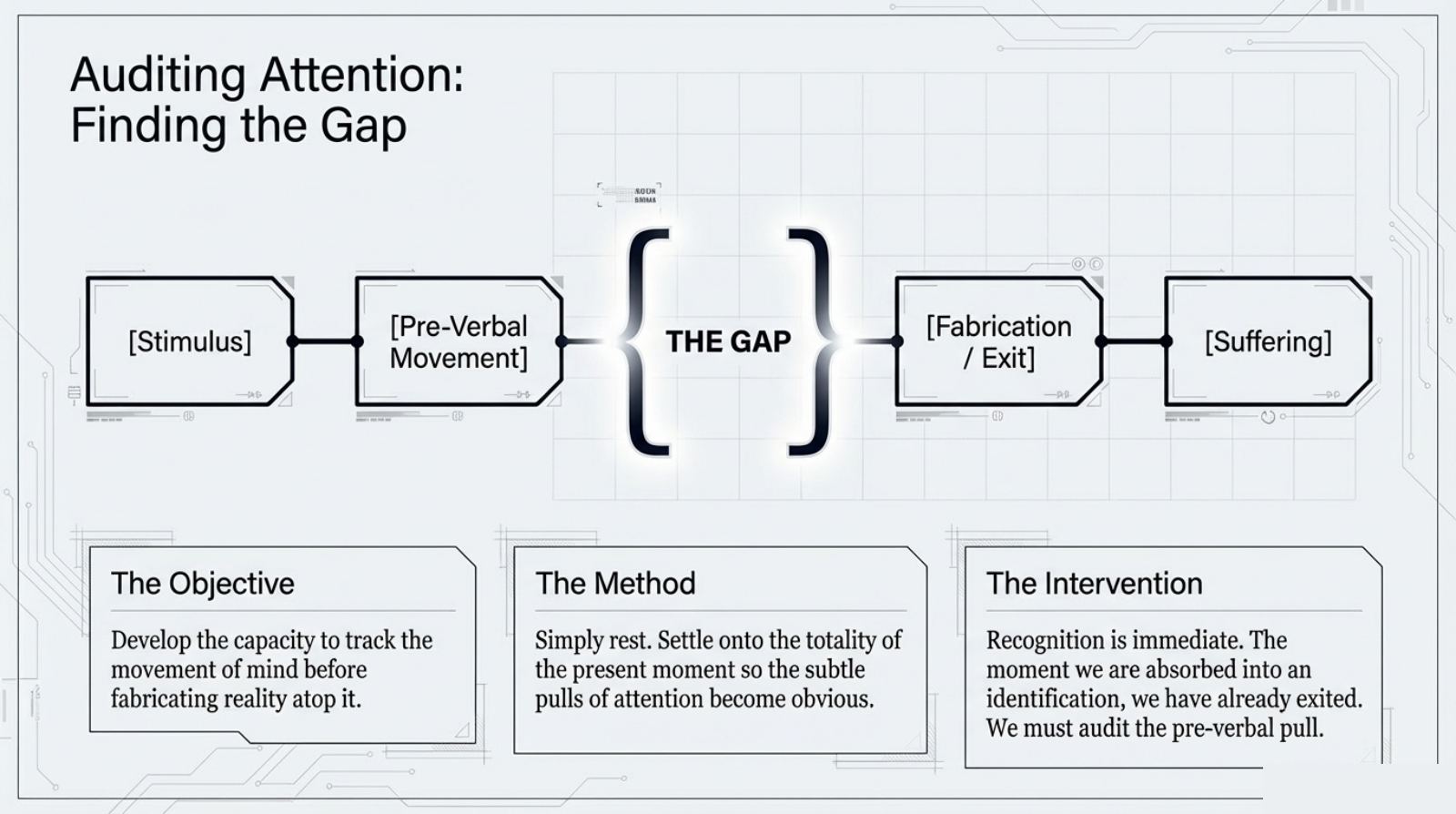
This is why there is no "recognition technique" that resolves it. The point is to become sensitive enough to detect the movement before it hardens into reflective commentary. The sit is not for manufacturing a special state. It is for cultivating enough stability and honesty that the subtle pulls of conditioning can be felt.
The difficulty of practice is hidden in our ways of not participating.
Attention, Contention, Intention
Three forces structure how the exit takes shape:
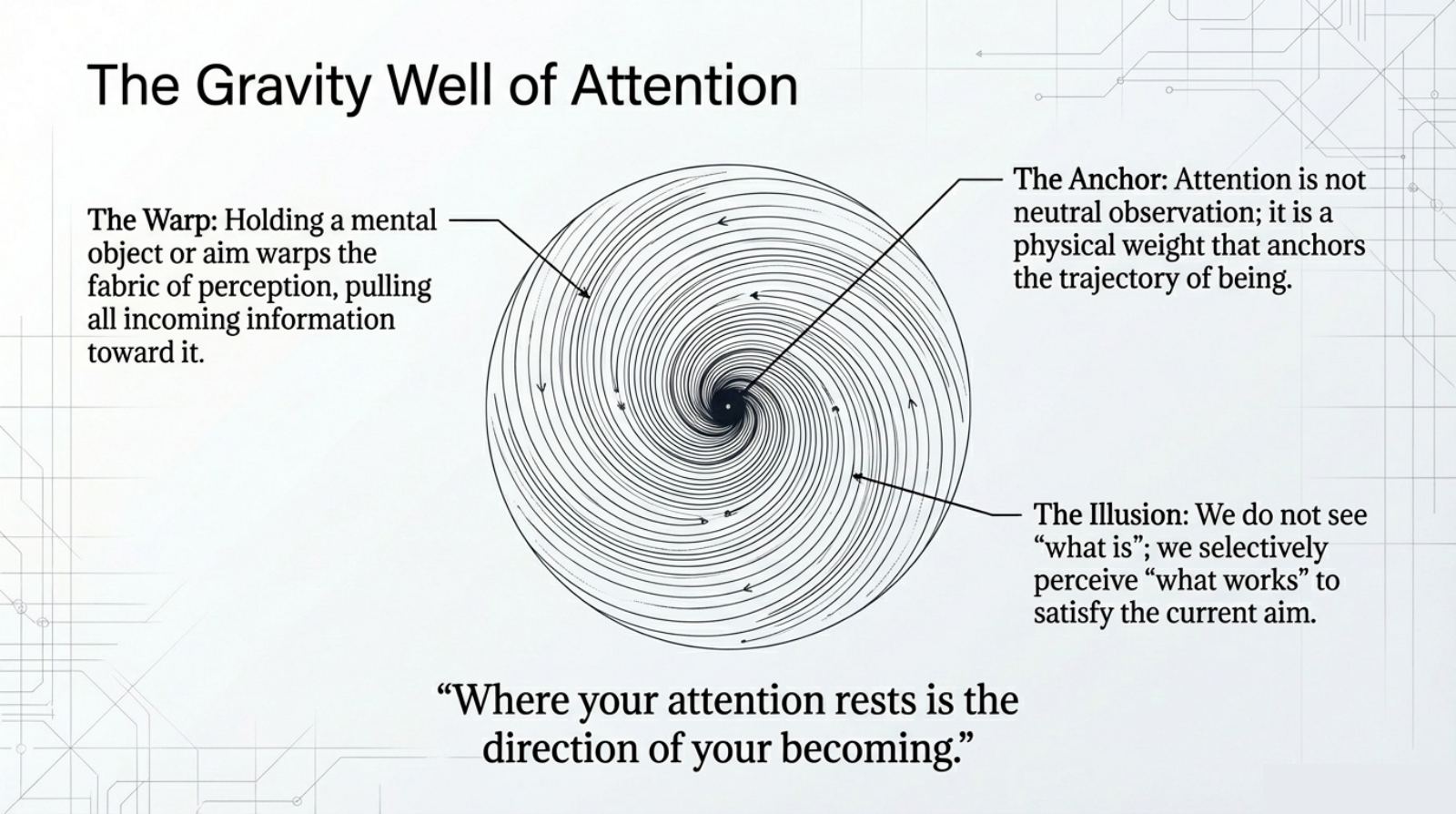
- Attention is not passive noticing. It acts as an orienting force — a gravity well. Where attention rests, becoming follows.
- Contention is the way mind divides, splits, and sets up oppositions within reality: here/there, wanted/unwanted.
- Intention is how the system leans, aims, and resolves itself based on those divisions. It takes the instability and turns it into a maneuver.
 Tap to enlarge
Why Life Cannot Be Excluded
Practice cannot remain a separate domain from life. The very conditions we normally avoid — friction, work, interpersonal difficulty — are the conditions that provide relevant feedback.
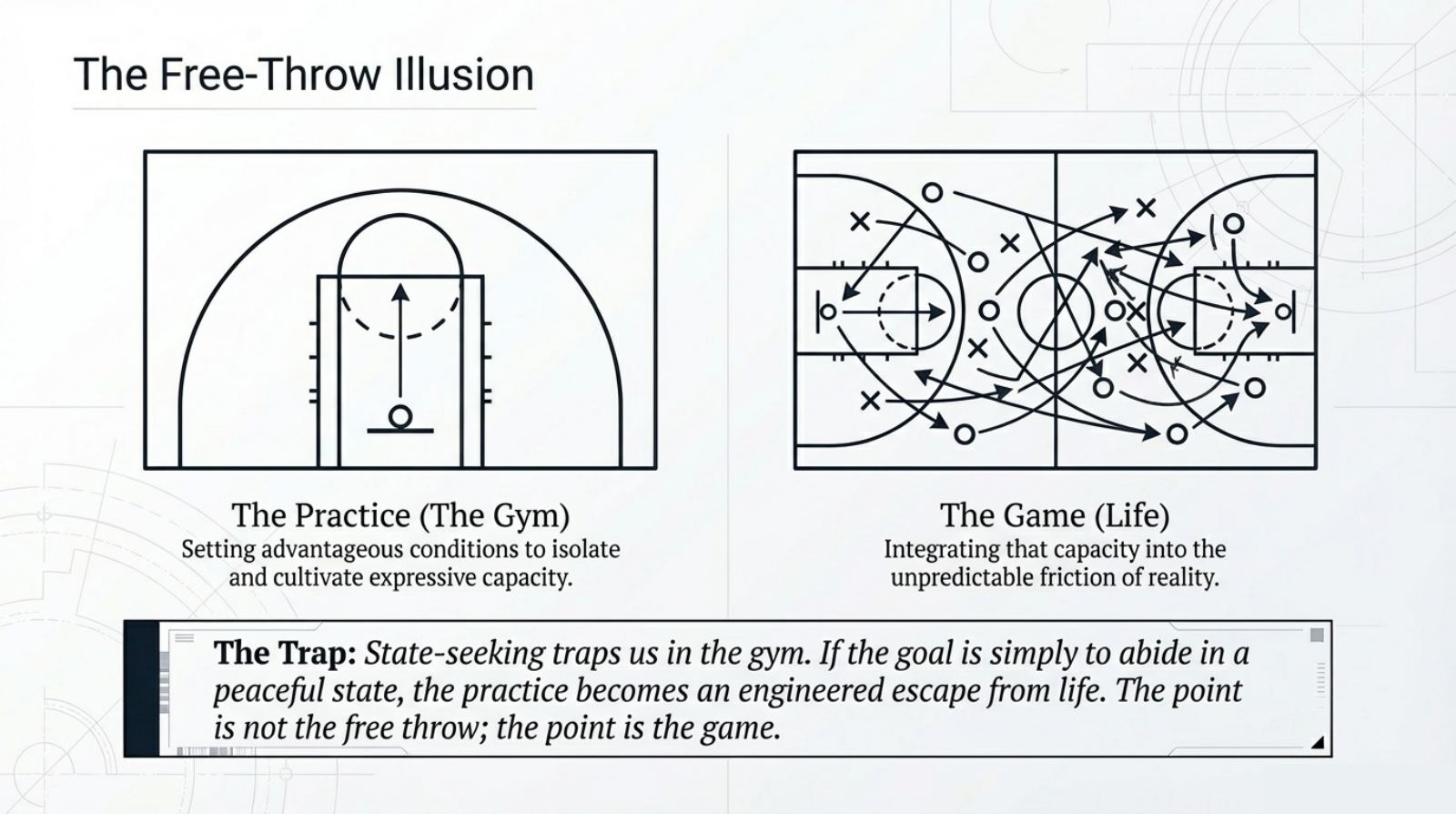
This is the free-throw illusion. You can engineer ideal conditions in a controlled environment. You can produce the feeling of clarity, calm, even insight. But a free-throw practice in an empty gym does not train what emerges when another player is guarding you and the crowd is loud and the clock is running. The isolated sit produces the illusion of progress; life reveals the actual game.
 Tap to enlarge
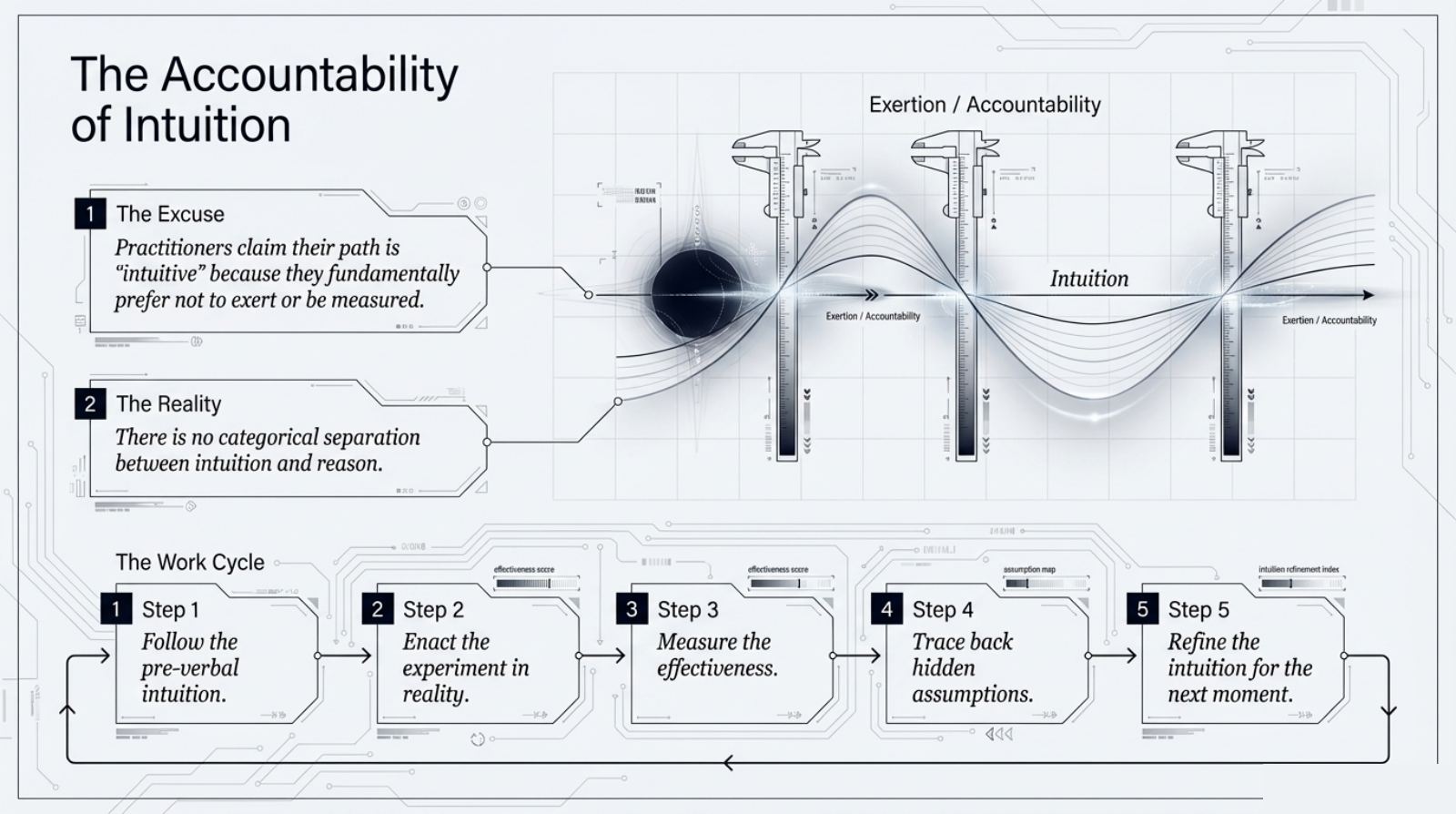
Discussion matters because it extends contact beyond silent state-management. Accountability matters because ignorance is maintained by not wanting to be seen.
Difficulty is not interference. It is the diagnostic field.
What Emerges for the Path of Training
- The path is less about attainment than about honesty. Notice how thoroughly you condition participation around comfort.
- Meditation is diagnostic before it is transformative. It is a laboratory in which the mechanics of leaving become visible.
- Stability is not the same as peace. You can feel calm because an exit maneuver has successfully stabilized the moment.
- State-seeking can become karmic reinforcement. If practice reproduces only pleasant conditions, it strengthens the loops that prevent recognition.
- Real training requires feedback beyond preference. You must enter situations where preference does not control the field.
- The point is not to destroy distinctions but to see them correctly. Functional distinctions are necessary. The error is treating them as fixed features of reality.
 Tap to enlarge
A Simple Map
Contact occurs → Attention is pulled → Contention splits reality → Intention leans toward stabilization → The exit maneuver forms → Relief appears → The loop is reinforced.
 Tap to enlarge
Suffering persists because the mind keeps teaching itself how to leave what it has not yet learned to include.
Final Synthesis
The exits are not just emotional habits. They are structural expressions of deeper assumptions about self and reality. What training must do is cultivate the capacity to rest, to audit the movement of attention, and to see how intention organizes a predictable escape from direct contact.
Practice becomes the work of reassociating with what you have been refusing — allowing life itself to reveal the places where the exit is still happening.
 Tap to enlarge
We cannot escape this conditional flow. We cannot escape ourselves. But we can collapse the distinctions between practice and life, and finally play the game.
Clips

If We See the Exit Strategy, Is It Still an Exit?
From Discussion 2, Room 1
Recognition collapses the exit — the moment awareness includes the pattern, it stops functioning as avoidance and becomes contact. Realization is staying in contact while the pattern occurs, not removing it. From Discussion 2, Room 1.

Authentic Needs vs. Exit Strategies
From Discussion 2, Room 1
Real needs are direct; exits carry hidden avoidance. The instruction isn't to fix what's found, but to recognize it and rest without resolving it. From Discussion 2, Room 1.

Watching vs. Being
From Discussion 2, Room 1
Watching can still be a subtle form of distancing; being dissolves the separation. Even awareness can function as an exit if it maintains distance. From Discussion 2, Room 1.