Seeing The Structure
How your patterns of engagement build the structure of your experience
Practice This Week
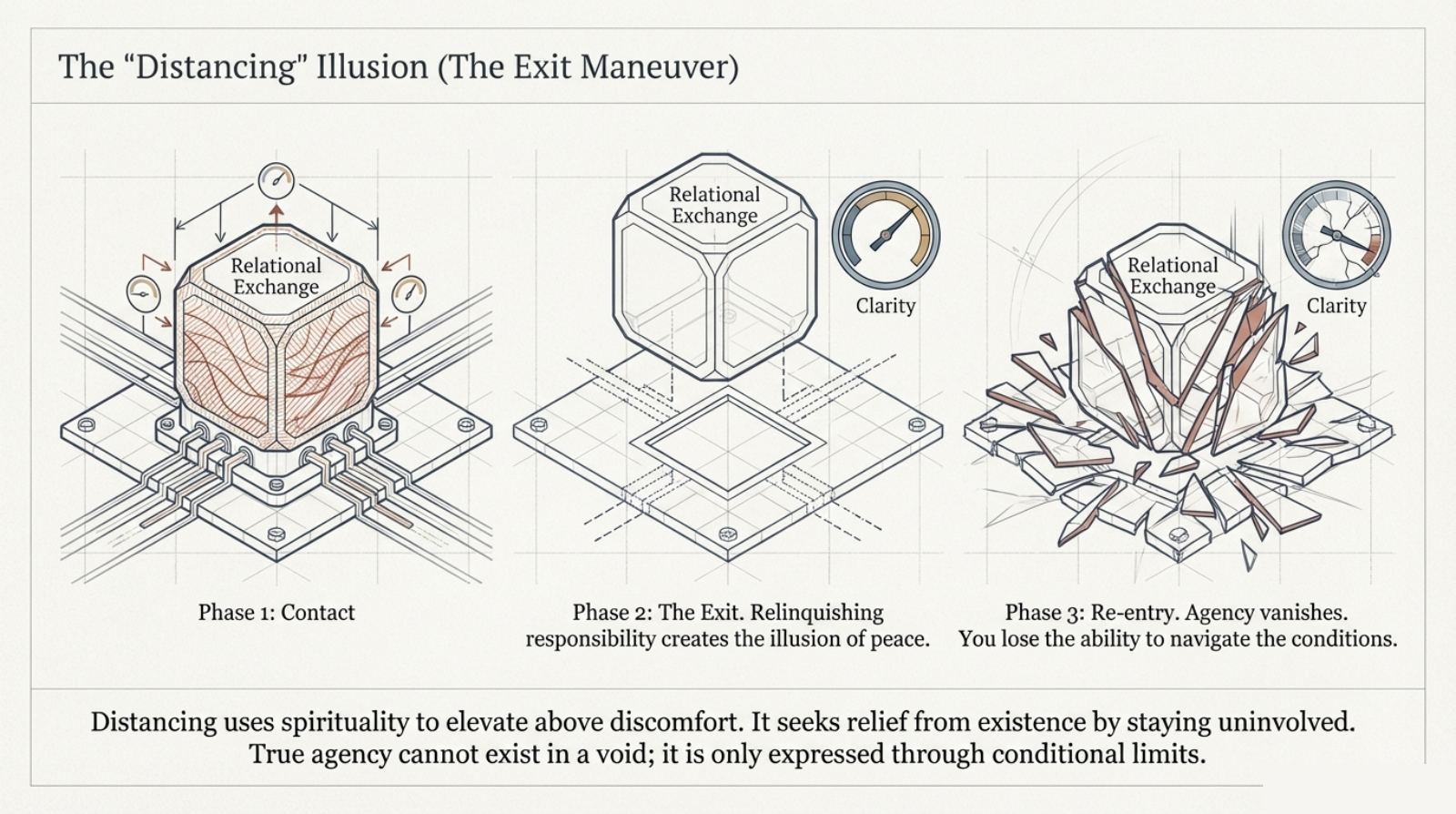
This week, catch yourself stepping back. In any moment of discomfort — relational friction, a sit that won't settle, a conversation going sideways — notice the move toward distance. Don't stop it. Just see it. See the moment you relinquish the field. That seeing is the diagnostic. Everything else follows from it.
Discussion
The live discussion room from this lesson. Watch it as another transmission — feel into the others as they ask questions and speak, and stay open to direct relating.

Discussion 3 - Room 1
Led by Albert
The complete Lesson 3 discussion room, unedited, led by Albert. Practitioners working the teaching in real time — questions, resistance, and live guidance.

Discussion 3 - Room 2
Led by Adrian
The complete Lesson 3 discussion room, unedited, led by Adrian. Practitioners working the teaching in real time — questions, resistance, and live guidance.

Discussion 3 - Room 3
Led by Shreyash
The complete Lesson 3 discussion room, unedited, led by Shreyash. Practitioners working the teaching in real time — questions, resistance, and live guidance.
Reading Material
From Situational Experience to Structural Reality
At a certain point in training, a subtle but irreversible shift arrives. Not a new technique. Not a more refined state to attain. It destabilizes the most basic assumption practitioners carry: that suffering is something that happens to them, based on the situations they encounter.
This lesson dismantles that assumption. It replaces it with something far less comfortable, but far more precise:
Suffering is not situational. It is structural.
This is not a philosophical claim. It is a description of how experience is actually generated.
 Tap to enlarge
From Events to Architecture
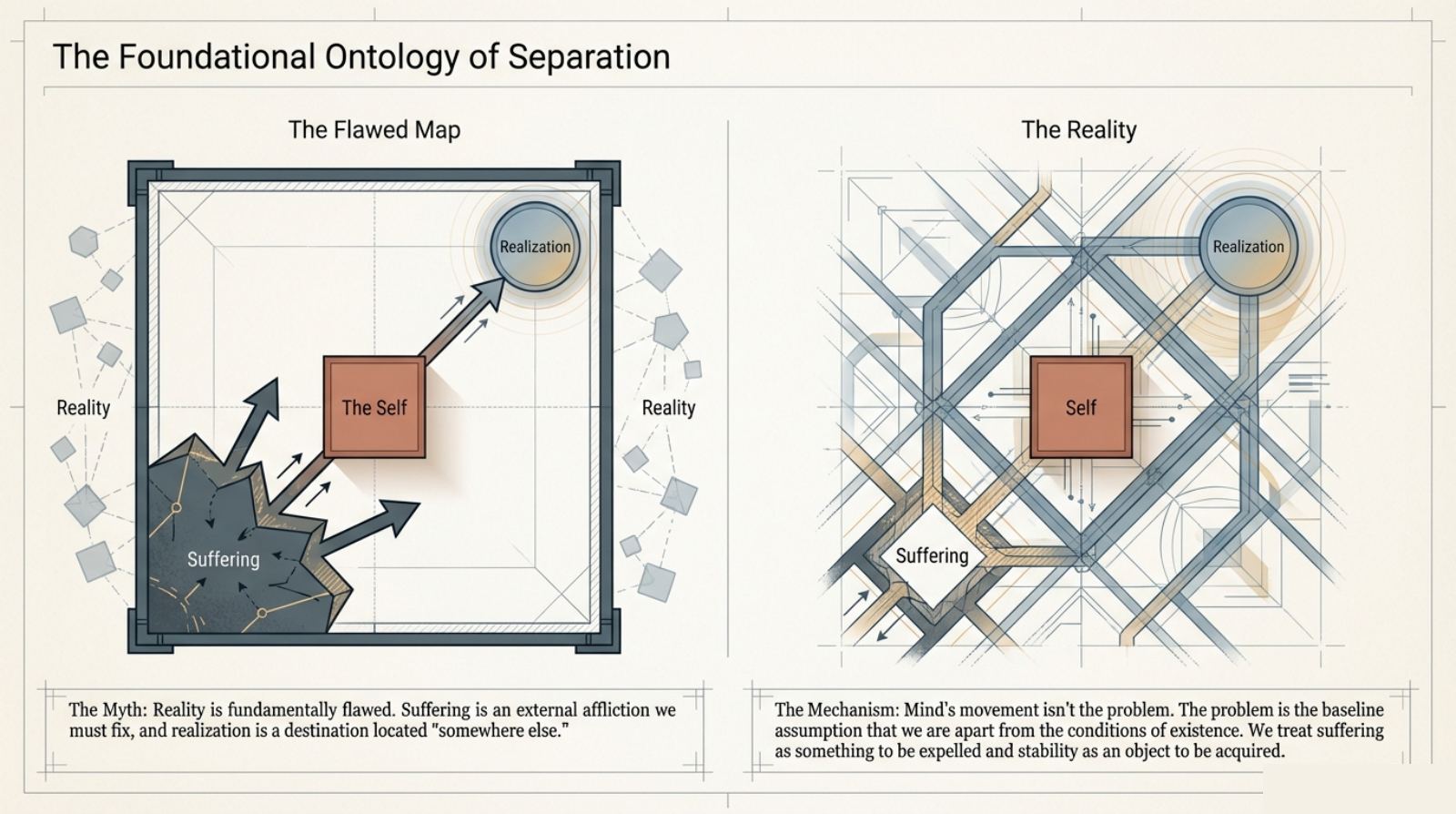
Ordinarily, experience is interpreted through a situational lens: this moment is difficult; this interaction caused tension; that condition created suffering. Within that framing, the path naturally becomes improving conditions, avoiding discomfort, optimizing states. But this entire orientation depends on a hidden assumption — that reality is fundamentally composed of discrete situations that we encounter.
What this lesson reveals is that framing is already downstream of something deeper.
 Tap to enlarge
Structural Reality
Each moment is not isolated. It is conditioned. And more importantly: each moment of participation prepares the conditions for the next. This produces a continuous chain — how you perceive, how you respond, what that response reinforces. Over time, this becomes stable. Not as a belief, but as a structure.
The Mechanism of Structuring
At the center of this process is a simple but pervasive mechanism:
- Attention orients toward what matters
- Contention arises when reality contradicts that orientation
- Intention resolves that tension through action
This is observable in real time. When attention destabilizes — when something does not align with what you expect or prefer — there is a moment of uncertainty. A gap. A loss of bearings. From that point, the system reorganizes itself. It moves toward coherence. And it does so through familiar strategies: Insisting (control), Distancing (withdrawal), Fading (collapse). These are not mistakes. They are solutions.
Why the Structure Is Invisible
The difficulty is not that this mechanism is hidden. It is that it is effective. The same force that allows you to recognize a stop sign, respond to language, and navigate complex environments is the force that stabilizes experience moment-to-moment. It works quickly. It works reliably. And because it works, it is not questioned.
Reinforcement Loop
Over time, this creates a closed system: preference establishes what matters; perception filters reality accordingly; reaction resolves tension; consequence reinforces the pattern; identity stabilizes the loop. What begins as a response becomes a tendency, then a trait, then a sense of self. At that point, the structure is no longer visible as structure. It is experienced as reality.
The Role of Preference
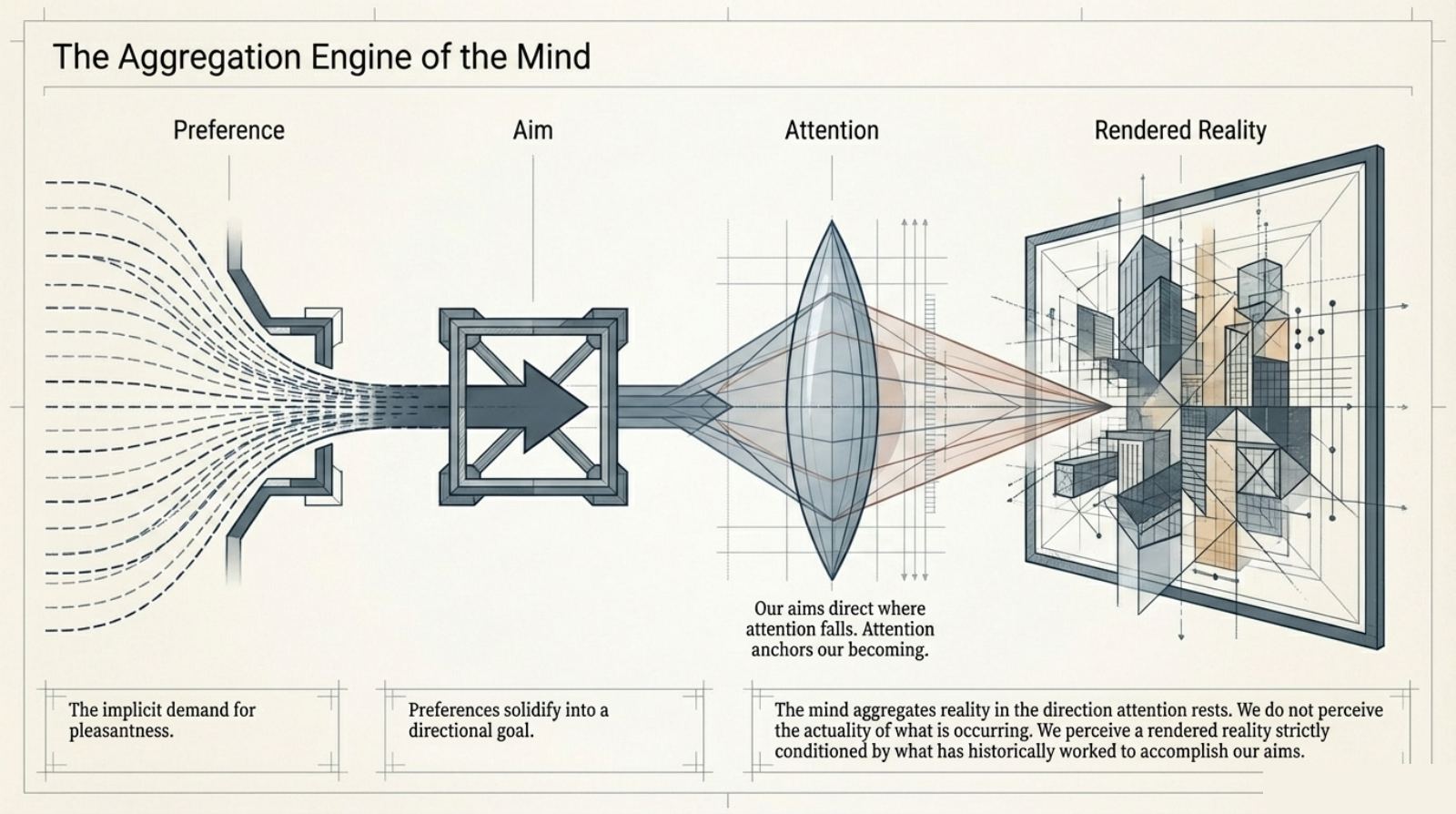
Preferences are not superficial biases. They are organizing principles. They function as aims that direct attention, conditions that determine participation, filters that shape perception.
We do not perceive what is occurring — we perceive what aligns with our aims.
This is why two people can inhabit the same situation and experience entirely different realities.
 Tap to enlarge
A Critical Distinction
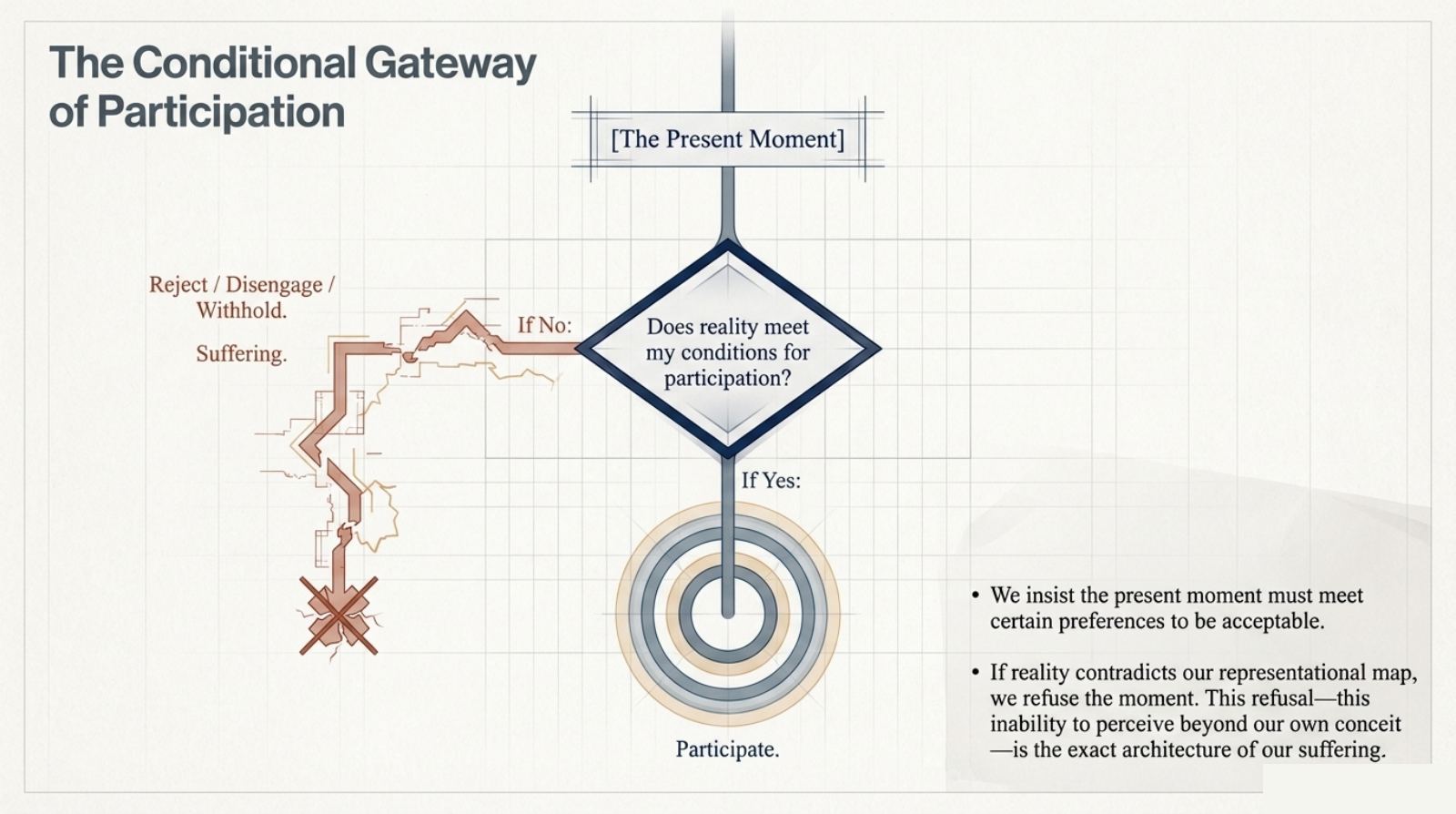
The problem is not having preferences. The problem is requiring reality to conform to them. When that requirement is present: participation becomes conditional, perception becomes selective, reality becomes distorted. This is the root of structural suffering.
 Tap to enlarge
Being as an Act
A central reframing emerges here: Being is not a noun. It is a verb. Existence is not static — it is enacted. And crucially, it is enacted within conditions. There is no agency outside of conditions. There is no participation outside of context.
The Hidden Move
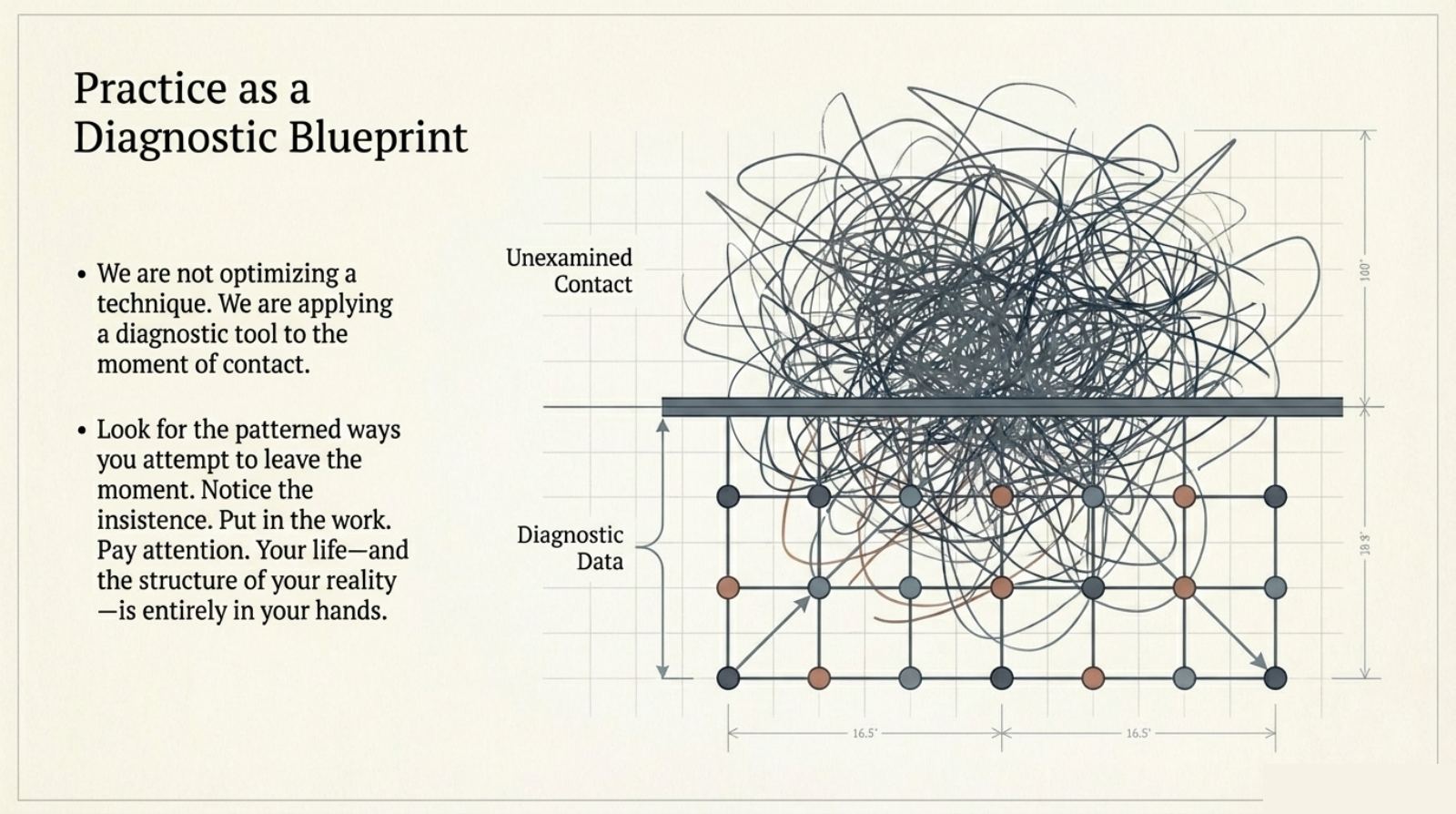
When discomfort arises, a common maneuver appears: stepping back, withholding engagement, seeking clarity through distance. This is often interpreted as wisdom. But functionally, it is a refusal to participate. One remains physically present, but no longer fully engaged. Responsibility is relinquished. The pressure of the moment is avoided. And with that, the capacity to act coherently diminishes.
 Tap to enlarge
Practice Reframed
At this point, the role of practice becomes clear. It is not a method for producing better states, a strategy for escaping discomfort, or a system for optimization. Practice is a diagnostic tool.
What Is Being Diagnosed
Practice allows you to see the moment attention destabilizes, the emergence of contention, the resolution through exit. More precisely: it reveals the patterned way you attempt to leave the moment.
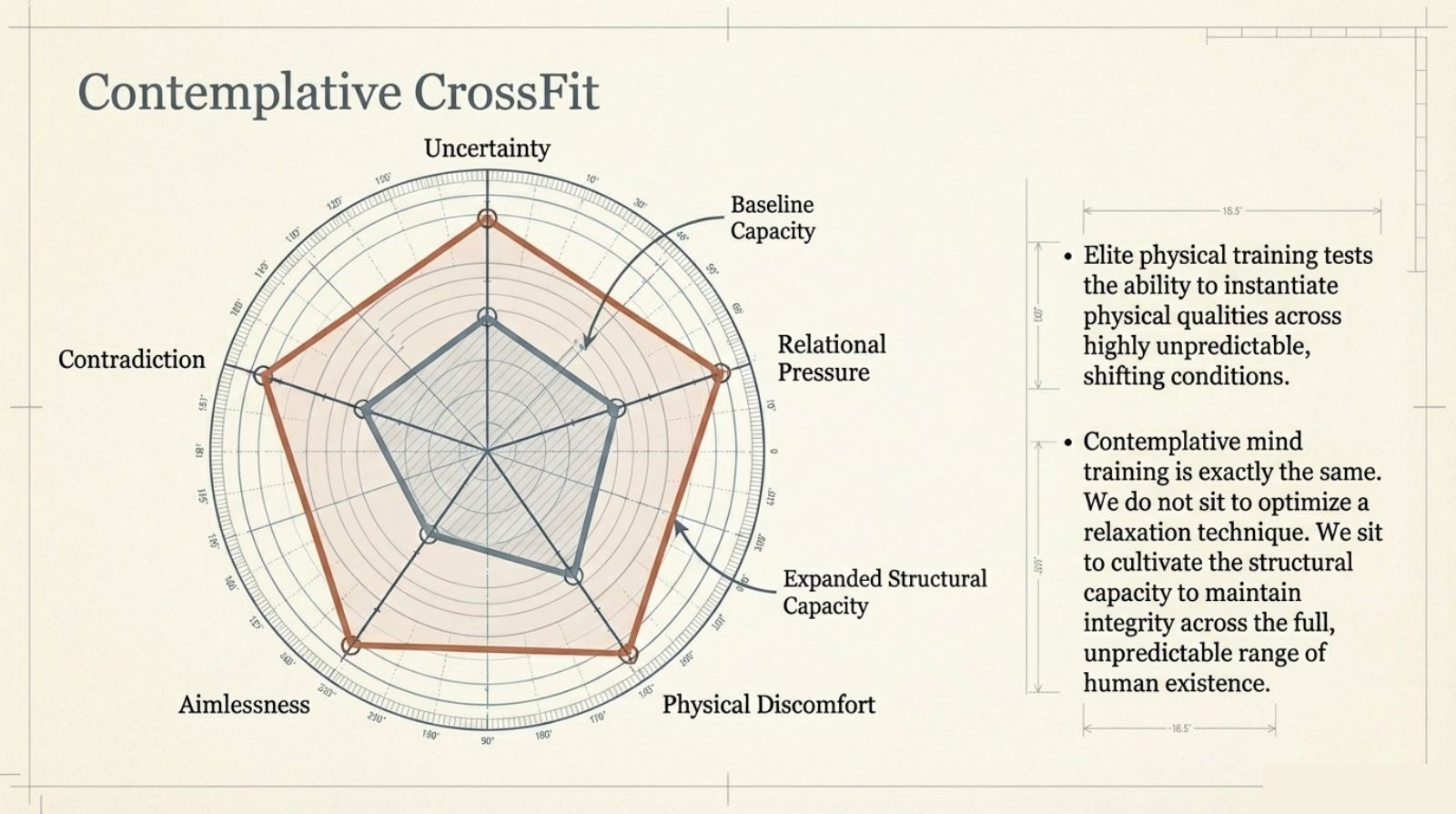
Training Across Conditions
This is where the CrossFit analogy becomes precise. The goal is not to perfect a single condition or to stabilize a controlled environment. The goal is to express coherence across a range of conditions: pressure, discomfort, relational tension, uncertainty.
 Tap to enlarge
Implication
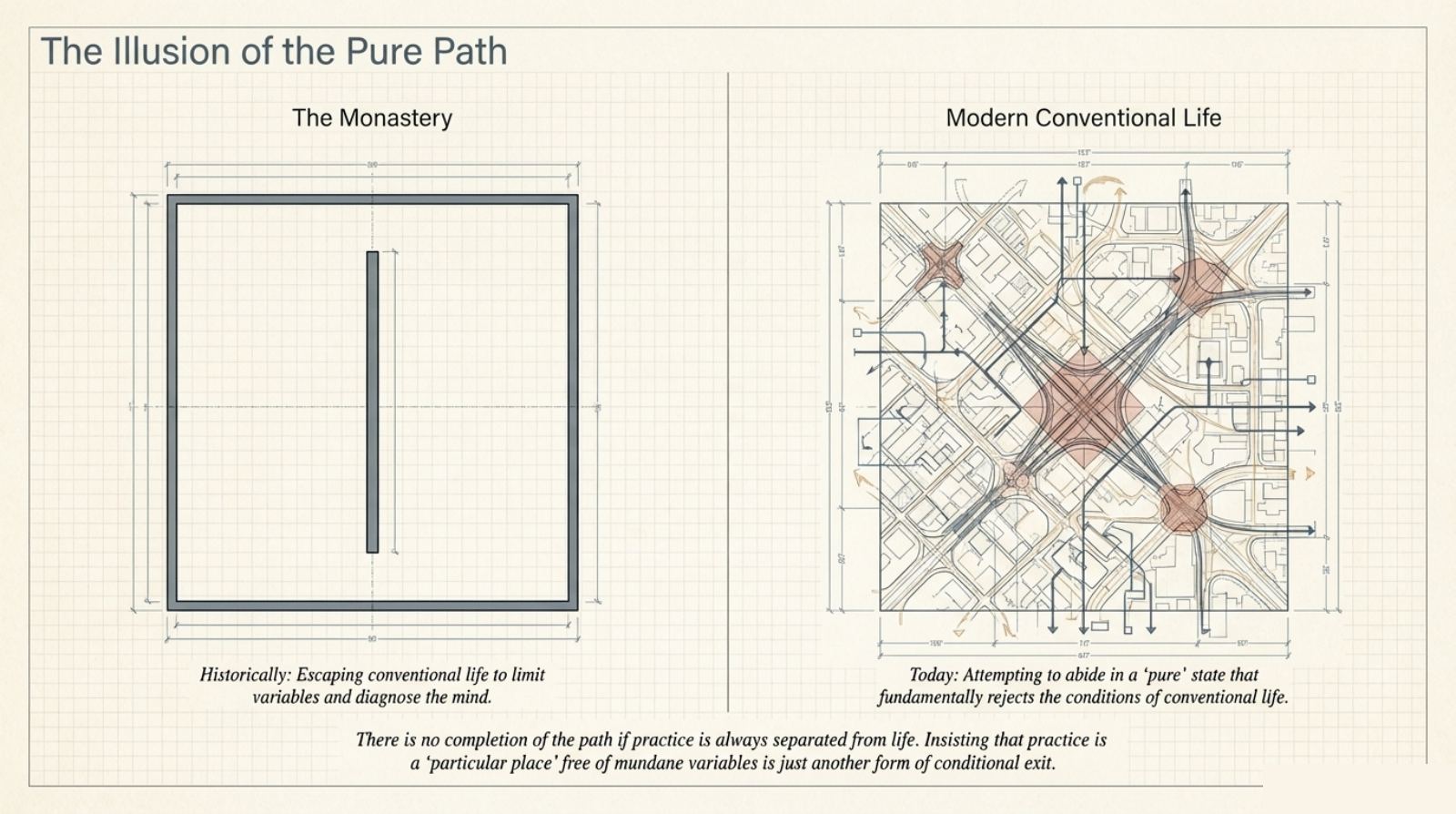
If practice is isolated from life, the structure remains untouched. If coherence only exists under ideal conditions, it is not coherence. It is conditional stability.
 Tap to enlarge
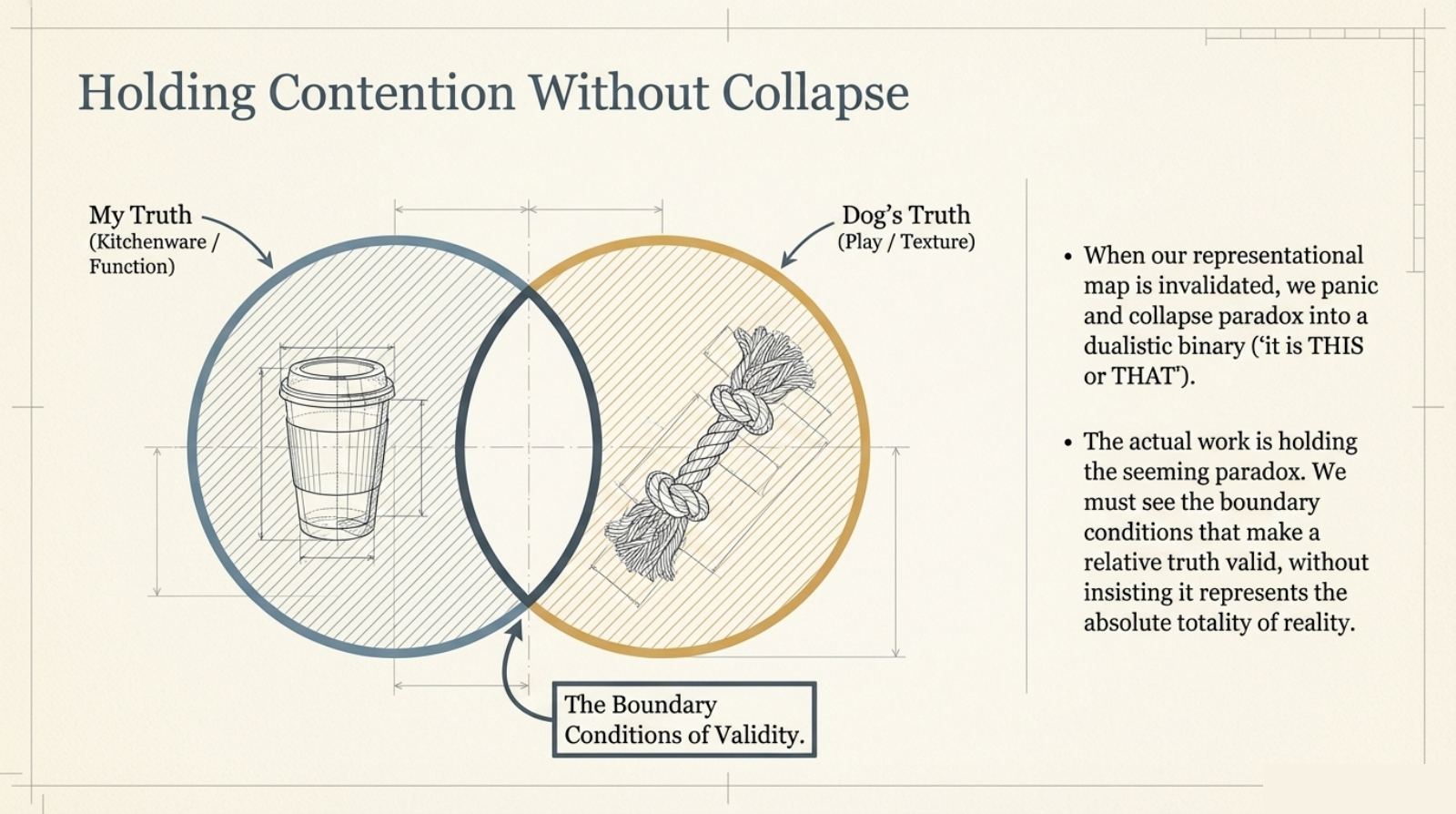
Holding Contention Without Collapse
At points of conflict — internally or relationally — there is a tendency to resolve tension by collapsing complexity: this vs. that, right vs. wrong, my truth vs. your truth. But this collapse obscures something important. Each perspective is conditionally valid and depends on a specific framework. To see this clearly requires holding both sides in tension without collapsing them.
Example
A simple object — a cup — appears as a drinking vessel, a weapon, a toy, depending on context. Each interpretation is partially valid and condition-dependent. Likewise, your interpretation of a situation is not the totality. But your response to it is still consequential.
 Tap to enlarge
Consequence as Structuring Force
Every decision shapes what becomes possible next. This is not abstract. It is immediate. How you respond conditions future perception; how you perceive conditions future response. There is no neutral moment.
Structural Continuity
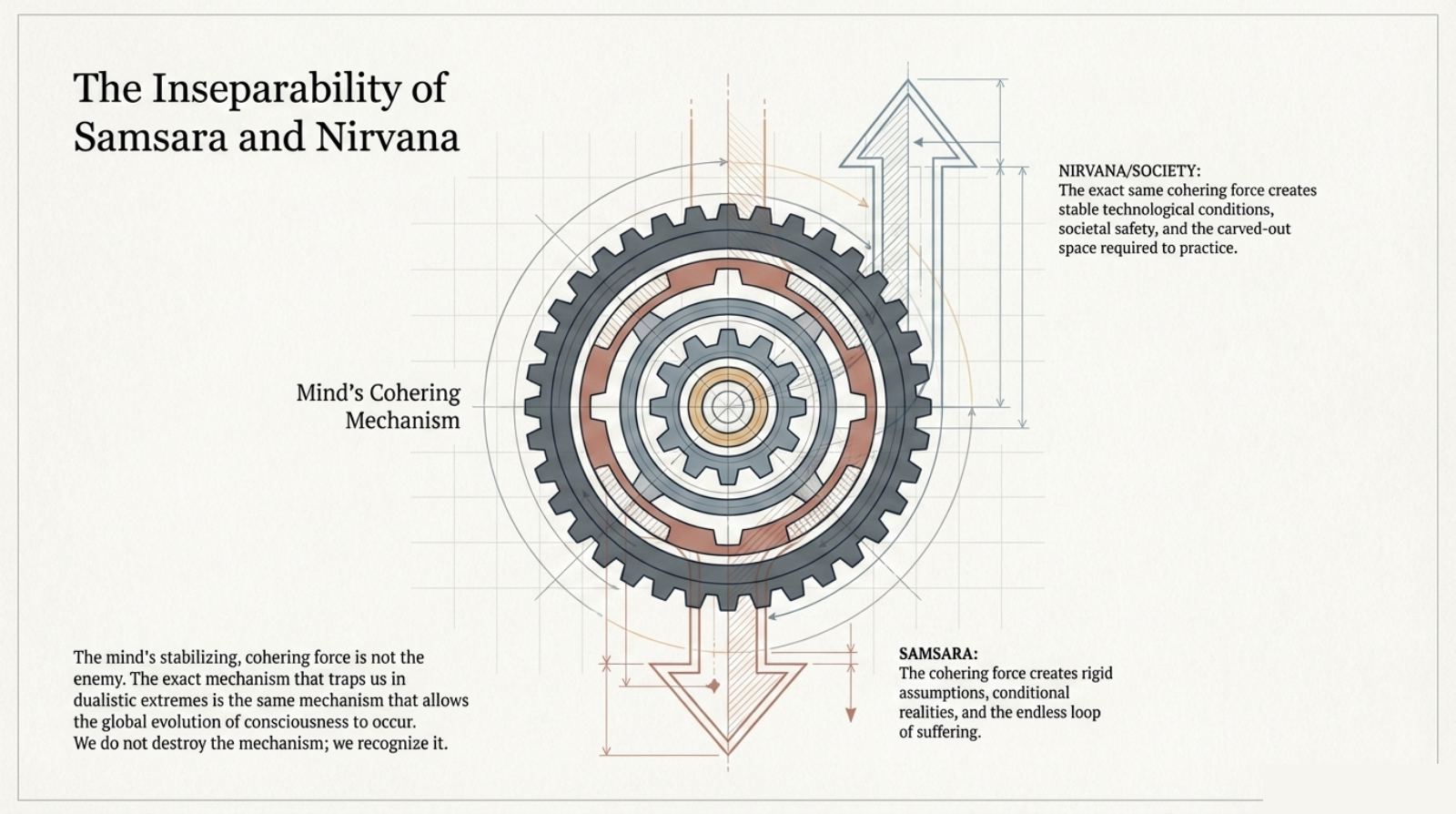
This is why samsāra is described as beginningless and endless. Not as a metaphysical claim, but as a functional one: the structuring mechanism does not stop.
Ignorance Reframed
Ignorance is not a lack of information. It is selective participation. Specifically: ignoring what contradicts our aims, reinforcing what confirms them. This maintains the structure.
The Path Clarified
At this point, the path undergoes a final redefinition. It is not leaving life, transcending conditions, or attaining a separate state. It is seeing how participation structures reality. And ultimately: recognizing that samsāra and nirvāṇa are not separate domains.
 Tap to enlarge
Final Compression
- Mechanism — Experience is structured through recursive participation
- Distortion — Treating suffering as situational
- Driver — Preferences shaping attention and perception
- Error — Requiring conditions before participation
- Correction — Recognizing exits as they form
- Practice — Diagnosing participation, not optimizing states
There is no separate layer of life where this applies. No domain where the mechanism turns off. No condition outside the structure. What you take to be reality is inseparable from how you participate in it — and that participation is continuously shaping what reality becomes.
 Tap to enlarge
Clips

Masterclass on Intimacy
From Discussion 3, Room 1
Intimacy reframed as non-withdrawal from experience — not emotional closeness, but the refusal to create distance from what is arising. This becomes the operational definition of being in contact. From Discussion 3, Room 1.

Fixing Internals via External Control
From Discussion 3, Room 1
Manipulating external conditions to resolve internal states is a structural misalignment — pure insistence disguised as problem-solving. From Discussion 3, Room 1.

Relief-Seeking & Endless Loops
From Discussion 3, Room 1
Seeking relief or cessation creates recursive loops — discomfort, seek relief, temporary ease, reinforced avoidance — locking practitioners into cyclical exit patterns. From Discussion 3, Room 1.