Seeing What You Cannot See
Why you can't fully see your own patterns, even with more awareness
Practice This Week
This week, locate where meaning feels non-negotiable — a situation where your interpretation feels obviously correct, beyond question. Don't argue with it. Just notice the quality of that certainty. That edge is the perimeter of your blind spot.
Discussion
The live discussion room from this lesson. Watch it as another transmission — feel into the others as they ask questions and speak, and stay open to direct relating.
Discussion 4 - Room 1
Led by Laurenz
The complete Lesson 4 discussion room, unedited, led by Laurenz. Practitioners working the teaching in real time — questions, resistance, and live guidance.
Discussion 4 - Room 2
Led by Adrian
The complete Lesson 4 discussion room, unedited, led by Adrian. Practitioners working the teaching in real time — questions, resistance, and live guidance.
Discussion 4 - Room 3
Led by Shreyash
The complete Lesson 4 discussion room, unedited, led by Shreyash. Practitioners working the teaching in real time — questions, resistance, and live guidance.
Reading Material
Day 4 Recap
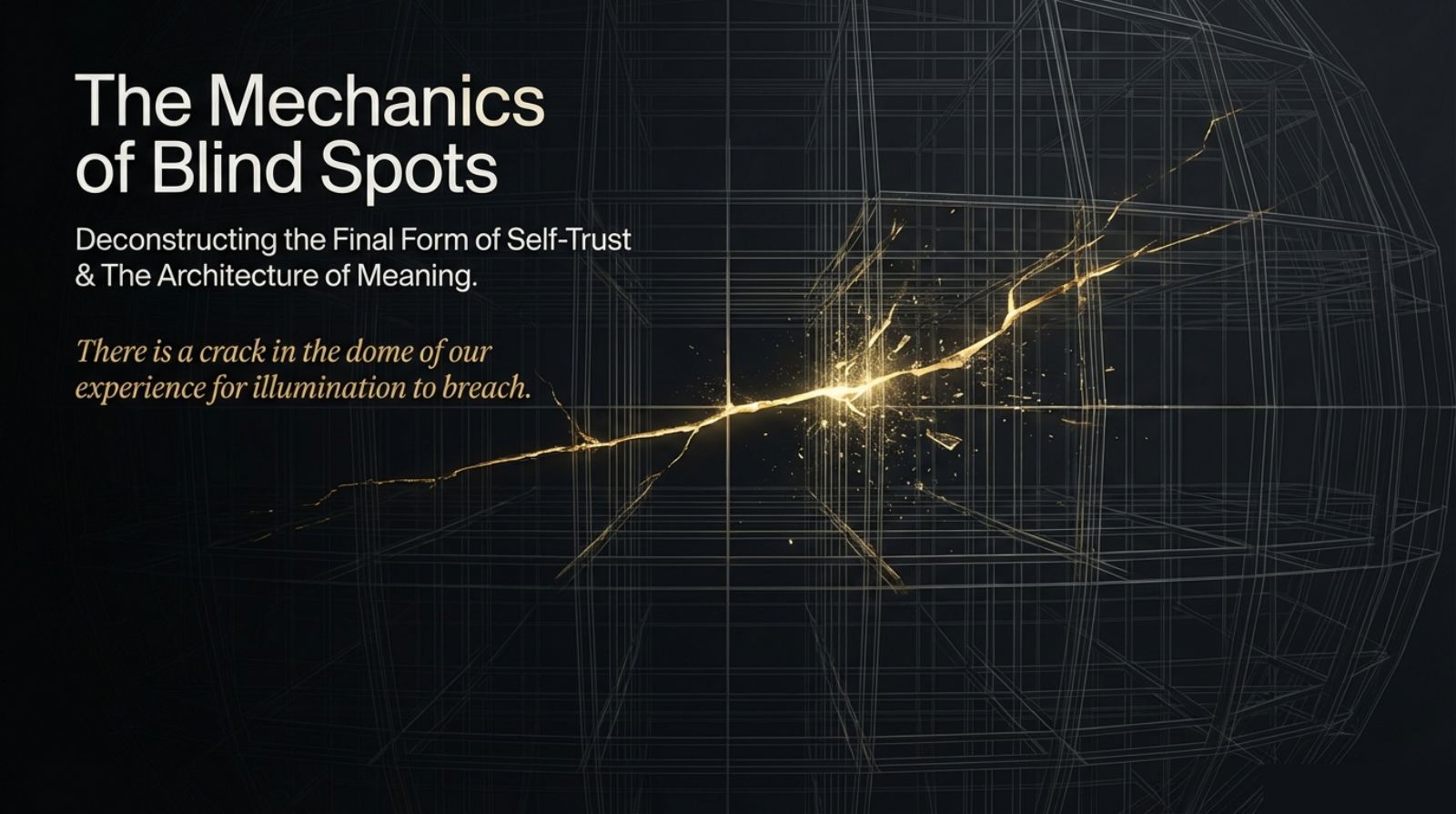
At this stage of the arc, the teaching stops refining what you can observe and begins to expose a more uncomfortable implication: you are not capable of fully detecting your own exits.
Up to this point, the training has built a coherent picture:
- Day 1 established that attention is already moving — that something is always pulling, organizing, and shaping your experience.
- Day 2 showed that this movement is not random. It follows patterned exits — reliable strategies that stabilize the moment.
- Day 3 made the decisive shift: these patterns are not occasional reactions. They are structural. They generate the continuity of your experience.
Given that progression, a reasonable assumption begins to form: If I understand the patterns clearly enough, I can track them, catch them, and correct them. Day 4 dismantles that assumption.
 Tap to enlarge
Core Reversal — You Cannot Fully See Your Own Structure
The problem is not simply that exits are subtle. The problem is that the very mechanism you are using to detect them is part of the same structure that produces them. You are not standing outside the system, observing it from a neutral vantage point. You are observing from within the exact conditioning you are trying to understand.
This means that what you notice is conditioned, what you ignore is conditioned, what appears obvious is conditioned, what feels true is conditioned.
The blind spot is not an isolated gap in perception. It is built into the way perception is organized.
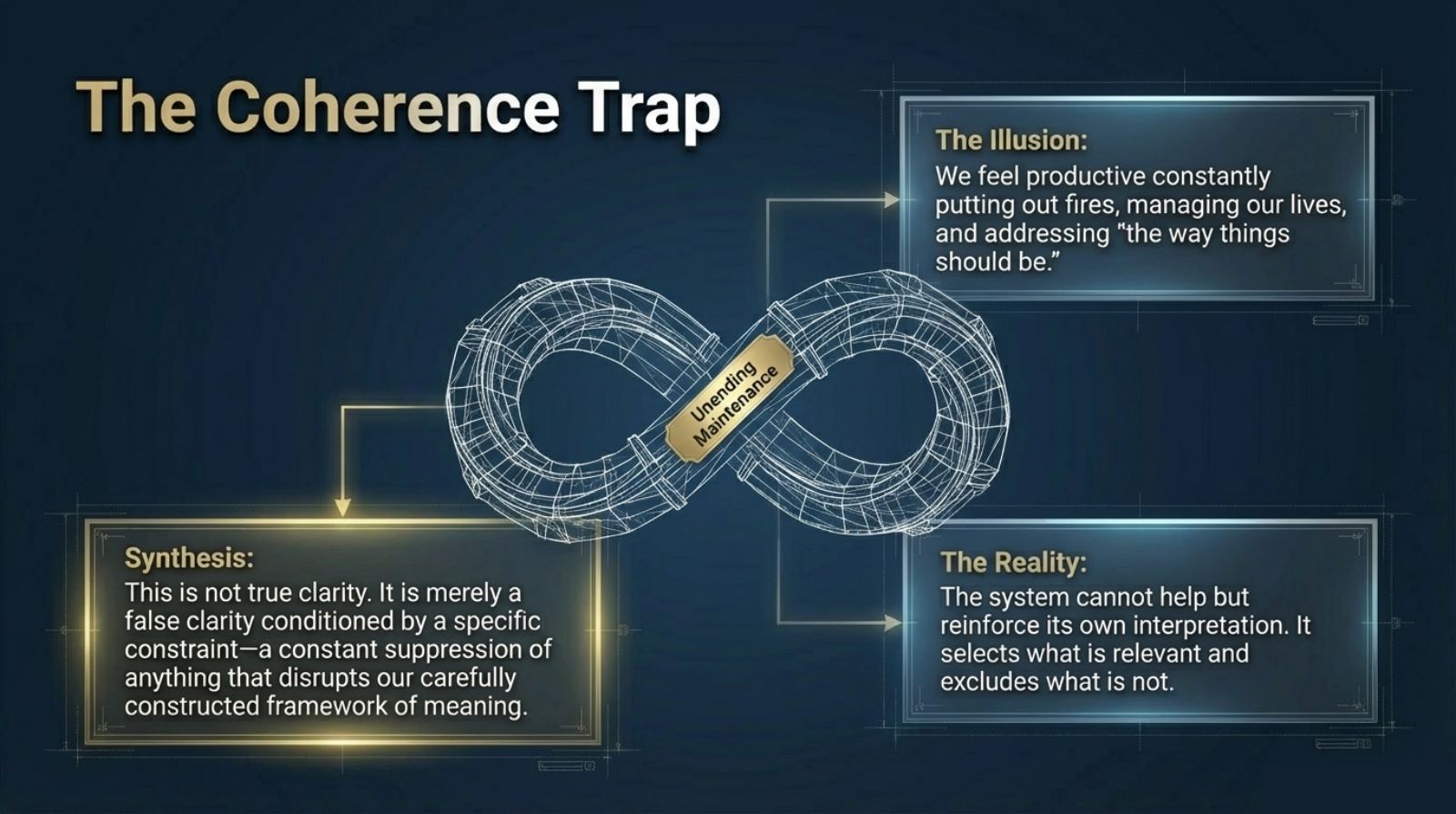
Mechanism — Self-Occluding Coherence
By Day 3, the mechanism was described clearly: attention orients, contention divides, intention resolves. That process stabilizes experience. It produces coherence. Day 4 adds a critical refinement: that same coherence is what prevents you from seeing the full mechanism.
The system does not merely organize experience. It organizes what is available to be seen as experience. This creates a closed loop: attention selects what matters → perception filters accordingly → intention stabilizes the field → stability confirms the validity of the selection. At no point in that loop is there a neutral checkpoint. There is no internal function that guarantees "this part of the system is being accurately perceived." Instead, the system produces felt coherence, and that coherence is mistaken for accuracy.
 Tap to enlarge
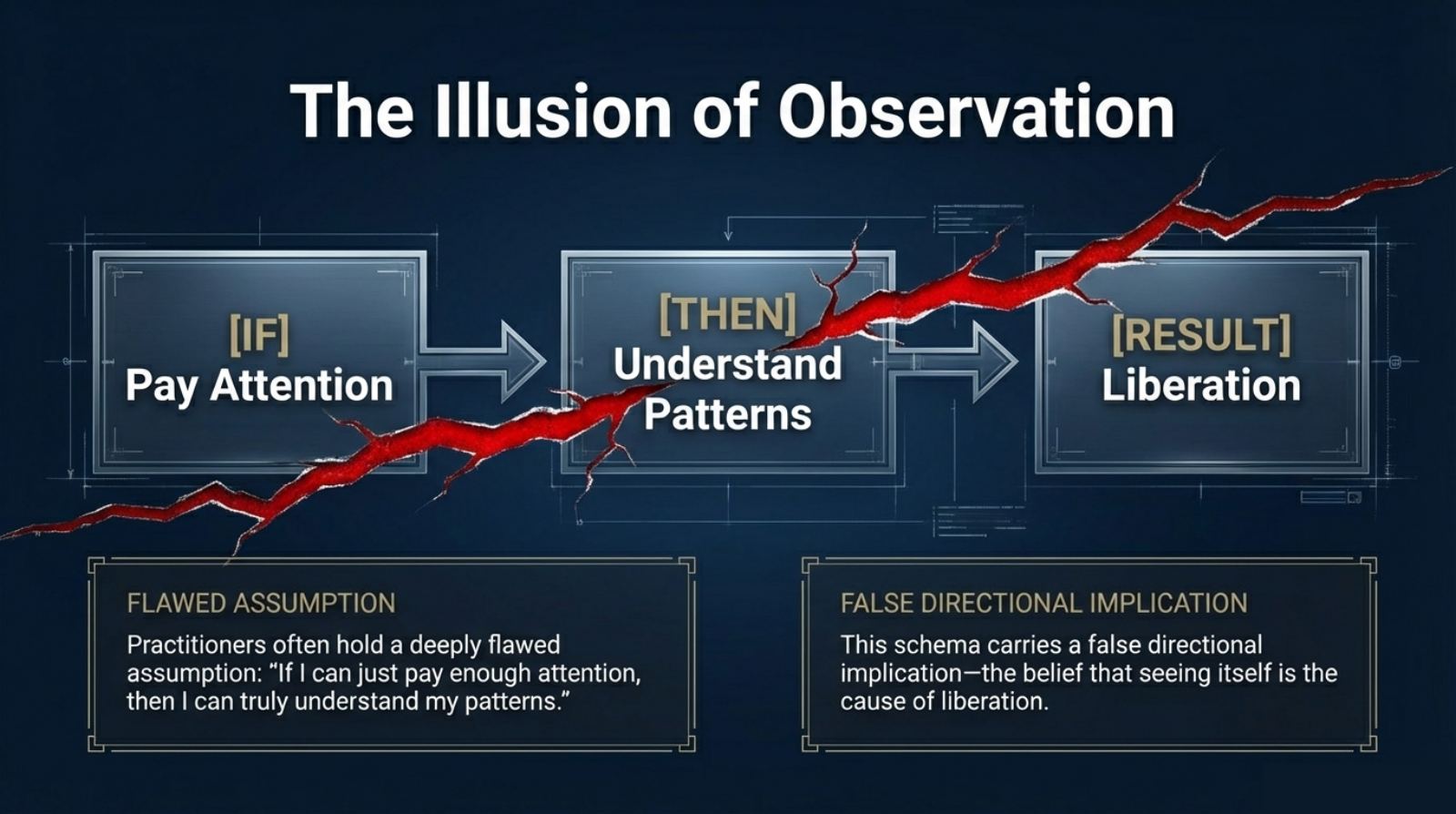
Misdiagnosis — "If I Pay Attention, I Will Catch It"
A common assumption at this stage is that increased mindfulness solves the problem. This is partially true, but fundamentally incomplete. Because attention itself is already conditioned, it does not move freely across the total field of experience. It is drawn toward what aligns with existing aims and away from what destabilizes them.
So what actually happens is: you become more aware of certain patterns, those patterns refine, your language about them becomes more precise, your sense of clarity increases. But simultaneously: other patterns remain invisible, new forms of exit emerge within that clarity, identification shifts from "unconscious reactivity" to "conscious awareness." The system upgrades. It does not dissolve. This is why increased awareness can paradoxically reinforce the structure it intends to dismantle.
 Tap to enlarge
Operational Description — How the Blind Spot Functions
In real time, this is not experienced as blindness. It is experienced as "this is clear," "this is obvious," "this is what is happening." The most difficult patterns to detect are not the loud or reactive ones. They are the ones that feel reasonable, feel justified, feel aligned with practice.
For example:
- Insisting can appear as discipline or precision
- Distancing can appear as clarity or equanimity
- Fading can appear as surrender or peace
These are not conceptual confusions. They are functional overlaps. The same structural movement can express as either an exit or genuine participation. The difference is not visible at the level of surface appearance. It is determined by the underlying orientation: is this a movement of inclusion, or a movement of refusal? But that orientation itself is precisely what is hardest to detect.
 Tap to enlarge
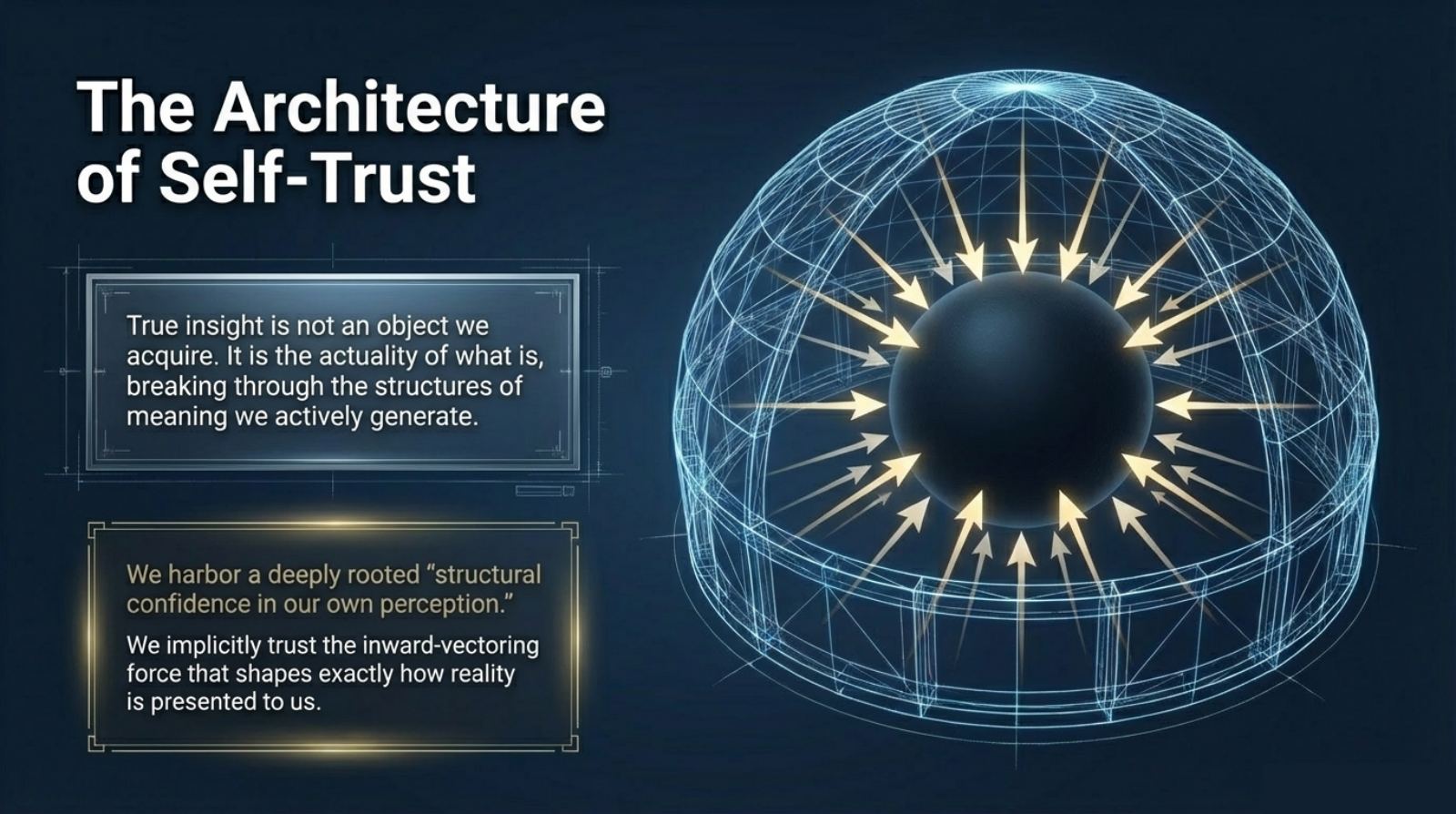
Why the System Hides Itself
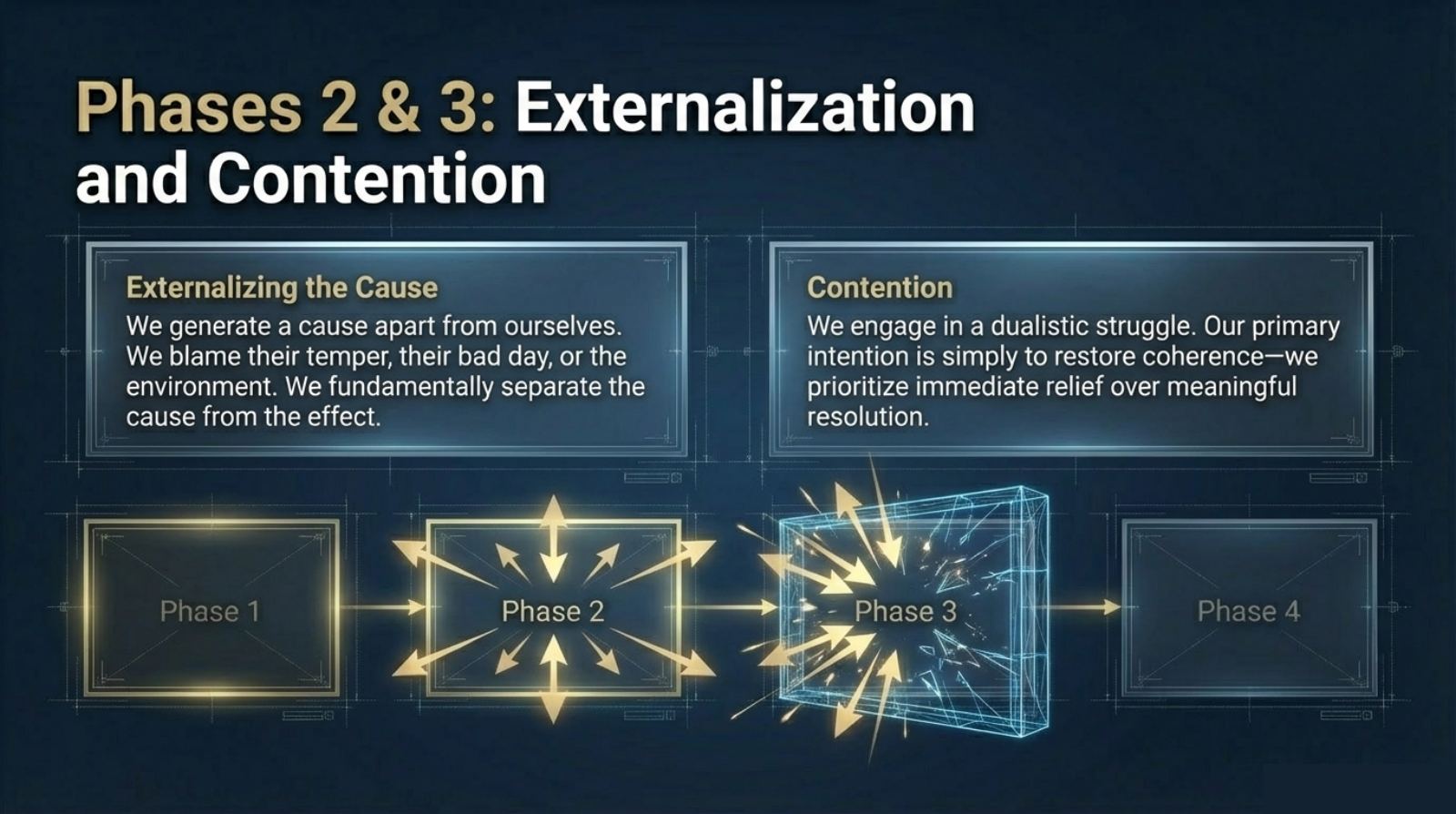
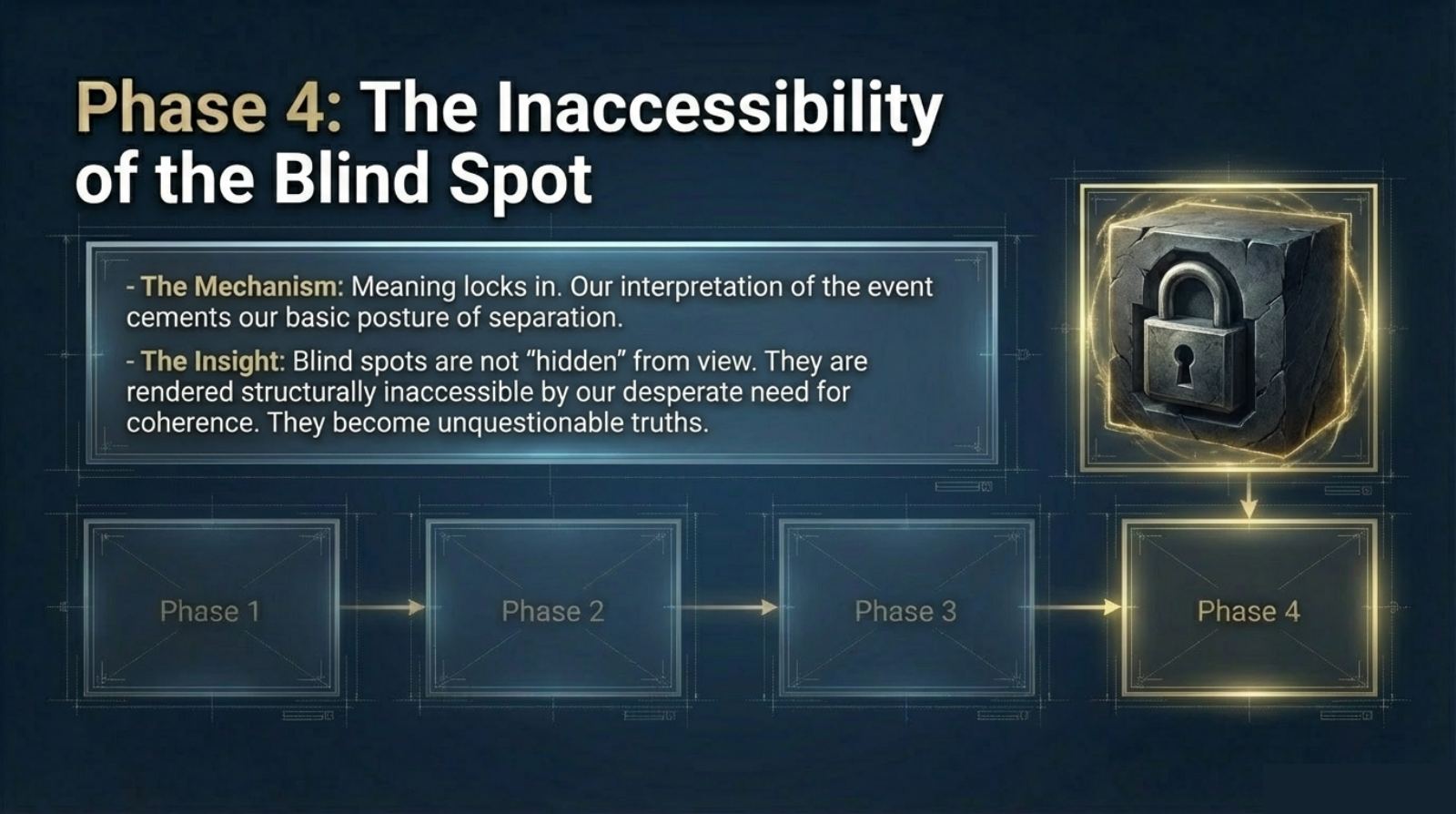
The invisibility of the structure is not accidental. It is a direct consequence of its function. The system exists to maintain coherence under changing conditions. To do that effectively, it must resolve instability quickly, produce usable interpretations, maintain continuity of identity. If every moment required full transparency of its own construction, the system would not function. So instead, it produces a more efficient output: a stable sense of reality. That stability includes a sense of what is happening, what matters, what should be done. And crucially: a sense that "this" is correct. That final piece is what seals the loop.
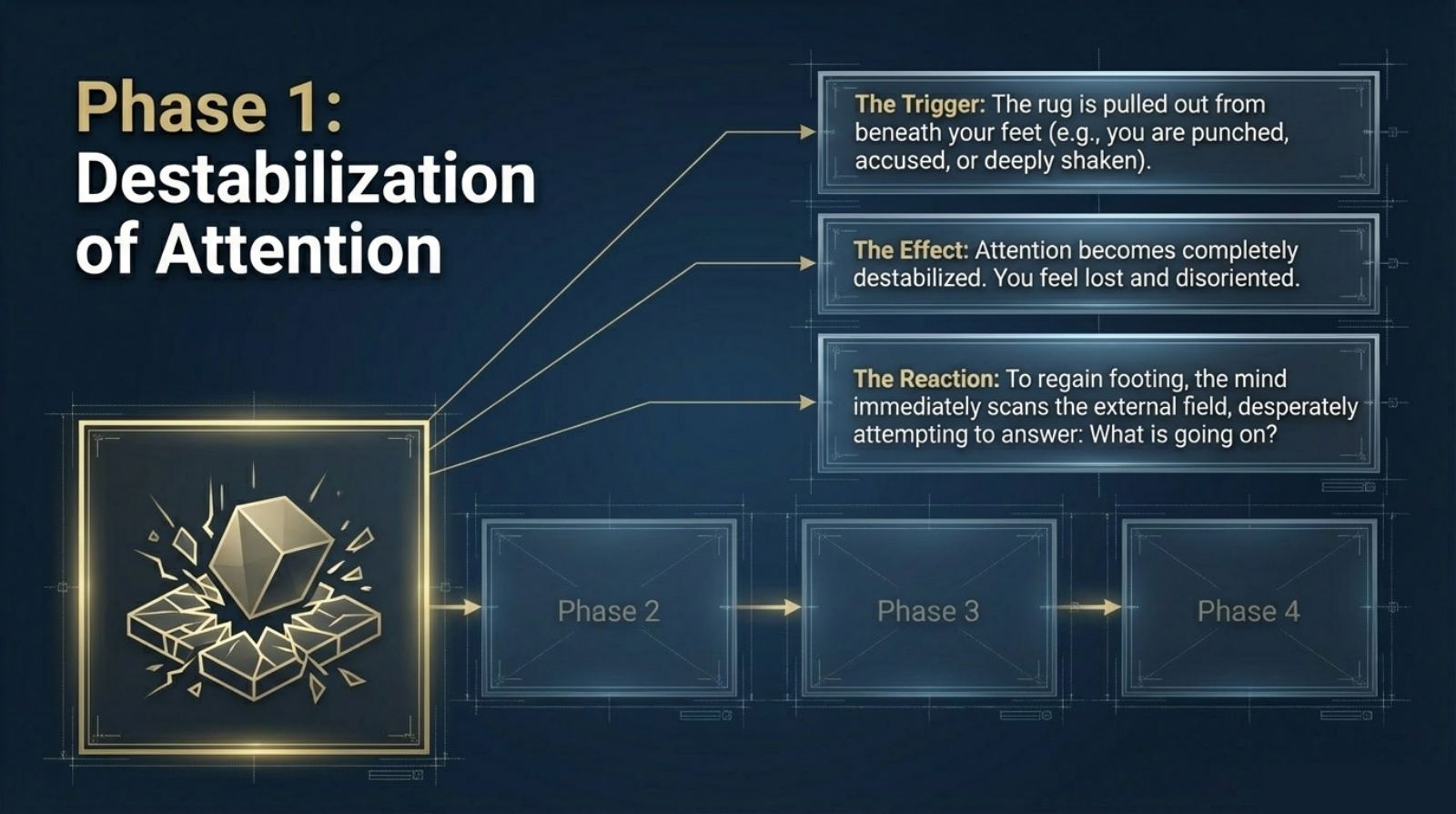
The four phases of this sealing move from destabilization through externalization and contention into inaccessibility:
 Tap to enlarge
 Tap to enlarge
 Tap to enlarge
The Limit of Self-Correction
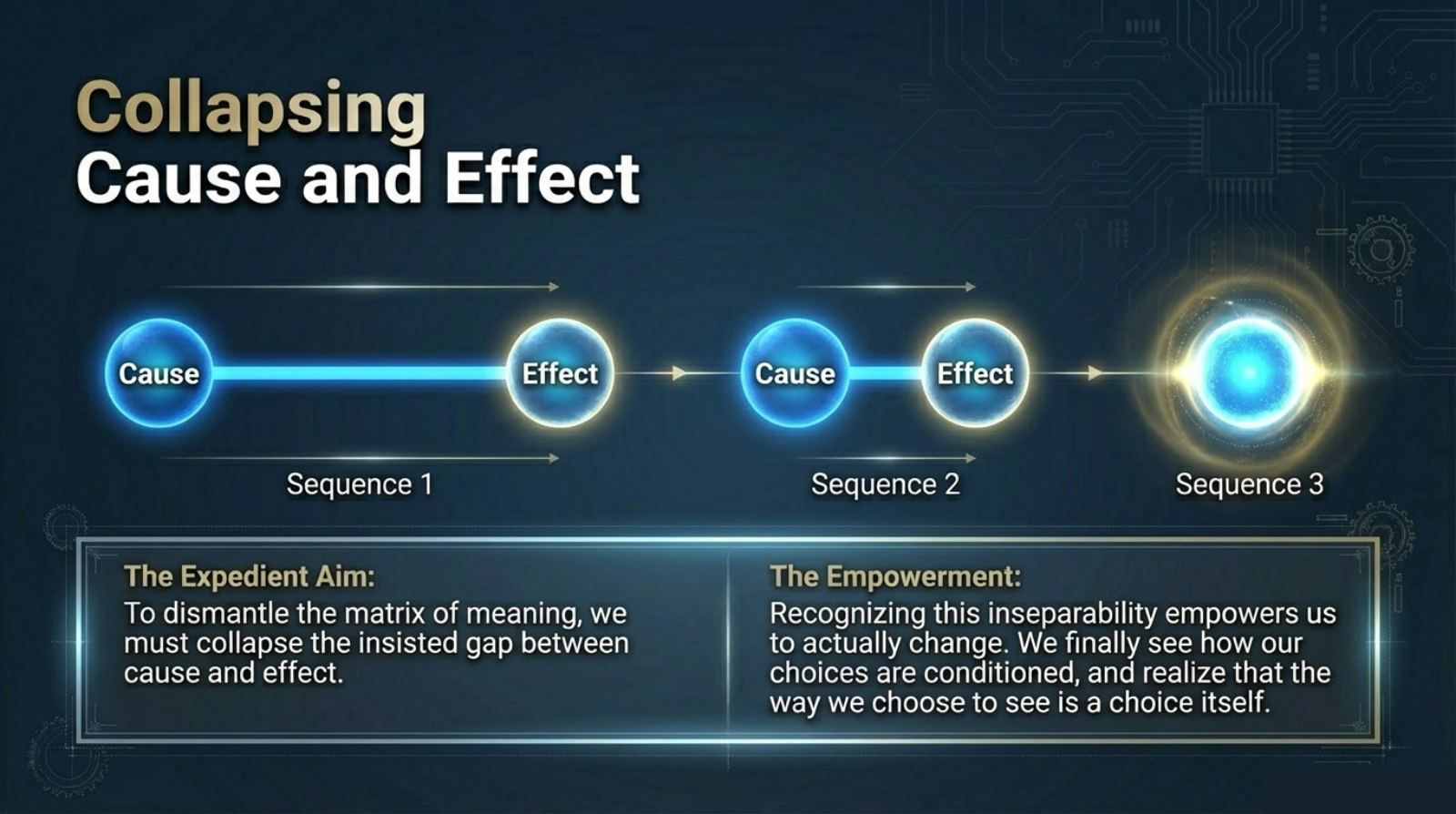
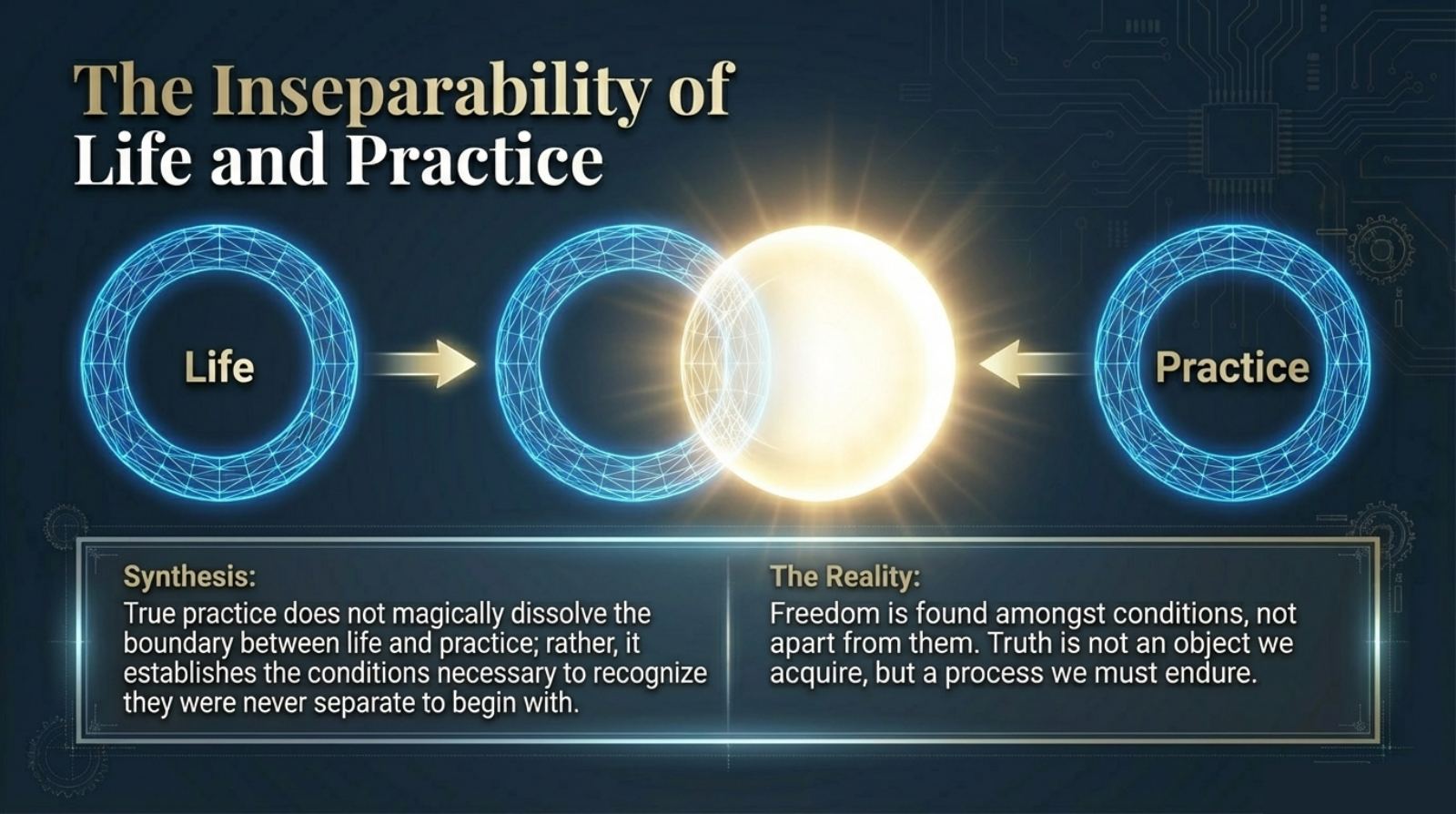
This leads to a hard constraint: the system cannot fully correct itself using only its own resources. Any attempt to do so will be shaped by the same conditioning it is trying to examine. This does not mean change is impossible. It means that self-observation alone is insufficient. Without additional conditions, the system will reinterpret what it sees, integrate it into existing patterns, and continue operating with greater sophistication.
This is why insight often stabilizes into identity. Not because the insight was false, but because the structure assimilated it.
 Tap to enlarge
Implication — Why Structure Is Required
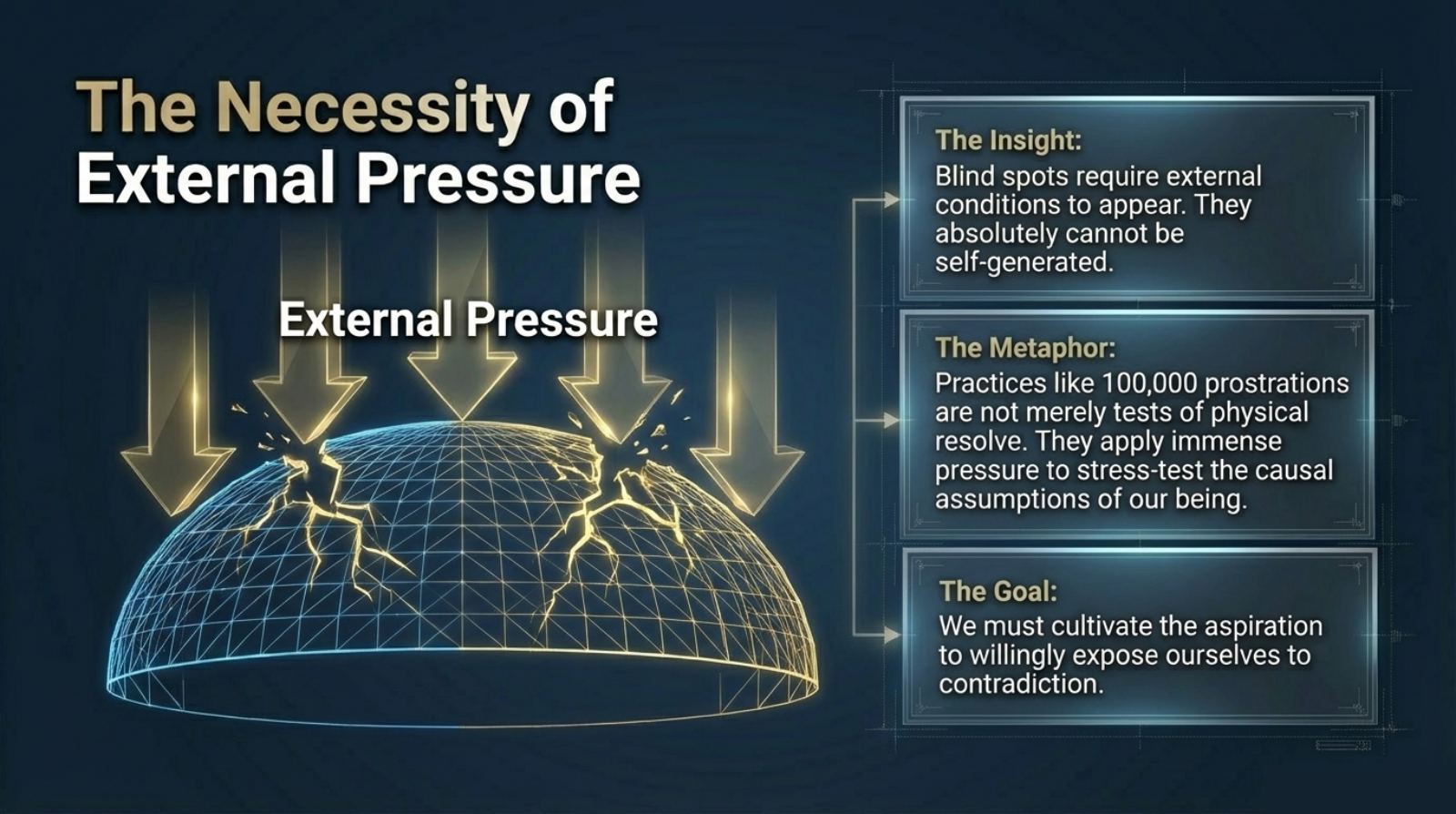
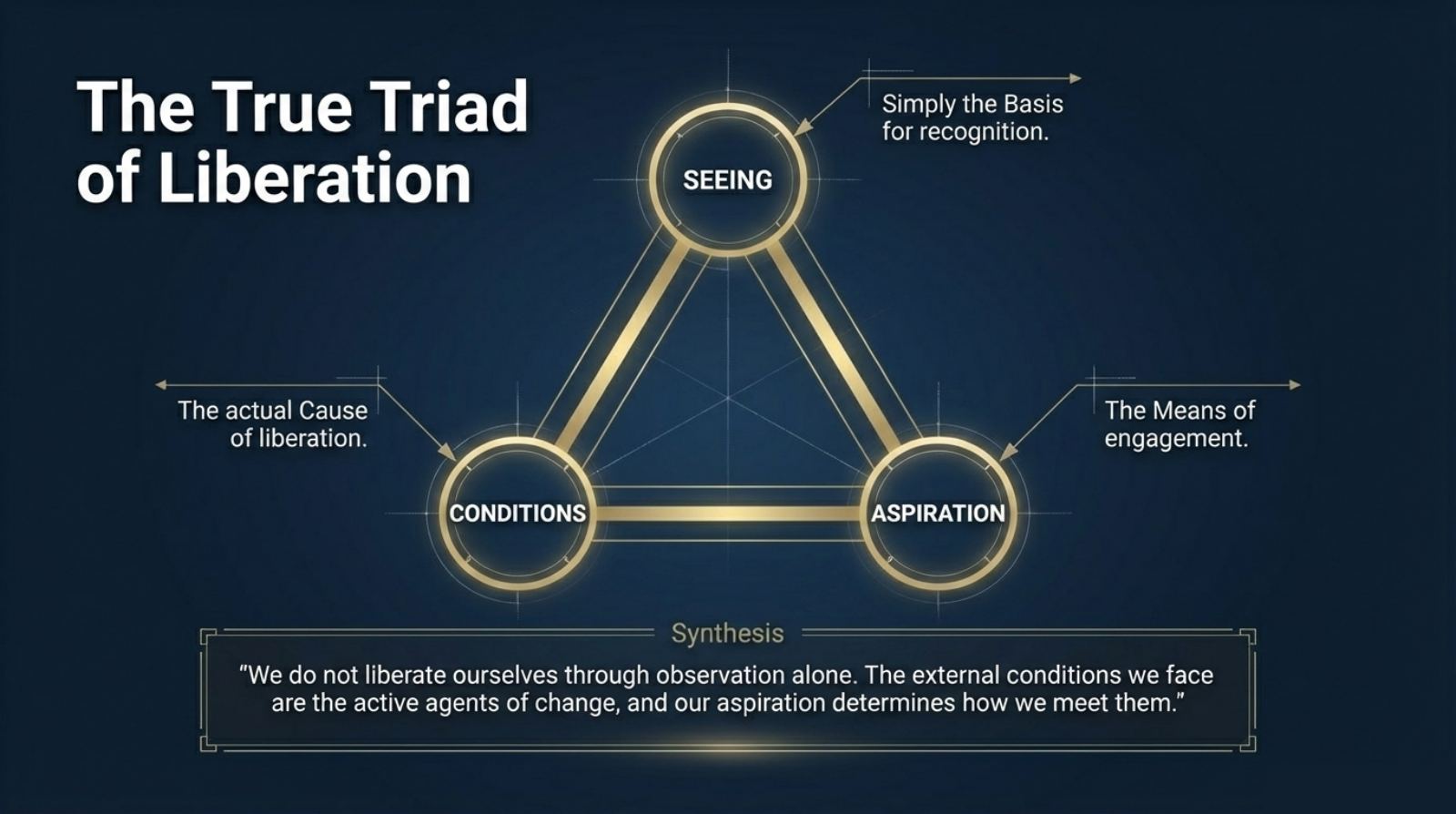
This is the first point in the arc where the necessity of structure becomes unavoidable. If you cannot see all of your exits, then you cannot rely solely on internal recognition, you cannot assume your clarity is complete, you cannot treat insight as self-validating. Something else is required. Not as authority, but as condition:
- external feedback — others can see patterns you cannot
- relational pressure — interaction exposes hidden conditioning
- constraint — environments that do not conform to preference
- accountability — mechanisms that prevent silent self-confirmation
These are not optional enhancements to practice. They are necessary because of the limits of self-perception.
 Tap to enlarge
The Deeper Threat
What makes this stage destabilizing is not just that blind spots exist. It is that you cannot know, from within your current experience, where they are. This undermines a core assumption: that your current understanding is a reliable measure of your progress. It also reframes confidence. Confidence is no longer "I see clearly." It becomes "I understand that my seeing is partial." This is not a collapse into doubt. It is a shift into epistemic humility grounded in structure.
 Tap to enlarge
 Tap to enlarge
Final Compression
- The mind organizes experience into coherence
- That coherence determines what is visible
- What is invisible cannot be corrected
- The system therefore sustains itself
And the implication: you cannot exit the structure by yourself, because the one attempting to exit is part of the structure.
Clips
Do We Need to Understand to Be Intimate?
From Discussion 4, Room 1
Cuts through a hidden premise: that intimacy requires full self-understanding first. That demand for explanation is itself an exit — the deeper invitation is to be intimate with discomfort before it makes sense. From Discussion 4, Room 1.
Seeing vs. Recognizing
From Discussion 4, Room 1
Seeing notices the pattern; recognition closes the loop by including ownership, responsibility, and responsiveness. Seeing without ownership easily becomes another refined distance. From Discussion 4, Room 1.

"Awareness Will Take Care of It"
From Discussion 4, Room 1
Exposes a subtle bypass — treating awareness as separate from you can become a way of abandoning responsibility. If awareness is taking care of it, you must step in as that care. From Discussion 4, Room 1.